
Consider Open Enrollment your designated annual period to conduct a full-scale portfolio review—not for your investments, but for your health. This is not a mere administrative task. It is the critical window during which you can proactively align your health coverage with your family's evolving needs and your financial strategy for the year ahead.
Understanding Your Annual Health Insurance Window

The concept of a strictly limited enrollment period is not arbitrary; it is the bedrock of a stable insurance market. To draw an analogy, imagine if one could purchase fire insurance after a house has caught fire. The system would be untenable. The same principle applies to health insurance.
A defined enrollment period prevents a situation where individuals sign up only when they anticipate needing significant, expensive medical care. Such behavior would create a lopsided risk pool, driving costs to unsustainable levels for all participants. By requiring everyone to enroll during a specific timeframe, insurers can maintain a balanced mix of healthy and less-healthy individuals, which is the mechanism that keeps premiums manageable.
For high-net-worth expatriates managing complex, international lives, missing this window is not a viable option. It means being locked out of making crucial changes, potentially leaving your family with substantial coverage gaps or significant financial exposure.
The Purpose of a Limited Enrollment Window
The system is deliberately designed to manage risk and maintain market predictability. Without this annual window, the market would be subject to "adverse selection"—a scenario where the only individuals purchasing insurance are those who are certain they will use it heavily.
This structured approach serves several key functions:
- Ensures Market Stability: It creates a predictable mix of members, which allows insurance carriers to balance their risk portfolios.
- Promotes Proactive Planning: It compels you to take stock of your health and financial picture annually, leading to more strategic choices.
- Controls Costs: A balanced risk pool is the single most important factor in keeping premium increases manageable across the entire market.
Open enrollment is not a bureaucratic chore; it is a strategic imperative. It represents the one time of year when you hold all the cards, with complete control to optimize your health plan and protect your assets. No special permission or life event is required.
This system was institutionalized with the implementation of the Affordable Care Act (ACA) in 2014, which created the health insurance marketplaces. Over the years, the timing and duration of the ACA's open enrollment periods have shifted with policy changes, affecting everything from the length of the sign-up window to the resources available to consumers.
For your reference, here is a breakdown of the core concepts underpinning open enrollment.
Open Enrollment Core Concepts
| Concept | Description | Strategic Implication |
|---|---|---|
| Defined Period | A specific, annual window to enroll in or change health plans. | Your primary opportunity for strategic health plan adjustments. |
| Risk Pooling | The practice of gathering premiums from a large group to pay for the claims of a few. | A limited window ensures a balanced mix of healthy and sick members, stabilizing costs. |
| Adverse Selection | The tendency for high-risk individuals to seek more insurance, skewing the risk pool. | Open enrollment prevents this by mandating a specific sign-up time for everyone. |
| Qualifying Life Event | An event outside open enrollment (e.g., marriage, birth of a child) that permits a plan change. | Your only mechanism to alter coverage outside the annual window. |
Understanding these pillars clarifies why this annual period is so rigid and why paying meticulous attention to it is non-negotiable.
Why This Period Demands Your Attention
If you take no action during open enrollment, your current plan will likely auto-renew. This is a significant strategic error. Allowing your plan to roll over represents a massive missed opportunity, particularly for expatriates.
Insurers modify their plans every year. Premiums change. Deductibles increase. Crucially for those living abroad, the network of physicians and hospitals can shrink or shift. The prescription drugs covered this year may not be covered next year.
The ideal plan for your family 12 months ago could be a poor fit today. For anyone traveling or living between countries, confirming the continued adequacy of your provider network is one of the most vital checks you can perform.
Should you have further questions, our dedicated FAQ section is an excellent resource for precise answers to common concerns.
Where You Shop for Health Insurance Matters
For expatriates, high-net-worth individuals, and anyone managing a global lifestyle, health insurance is not a simple commodity. It is a strategic asset. The venue where you procure it—the arena of enrollment—dictates the rules, timing, and the types of decisions you must make.
Consider it akin to acquiring a vehicle. You would not visit a city car dealership if you required a heavy-duty truck for an agricultural estate. The same logic applies to health insurance. The three primary arenas—employer-sponsored plans, the individual ACA Marketplace, and private international insurance—each serve a distinct purpose. Selecting the correct one is the foundational step to protecting both your health and your wealth.
Employer-Sponsored Group Plans
This is the most prevalent channel for health coverage in the United States. If you are employed by a U.S.-based company, you will almost certainly be offered a group plan. The company establishes the open enrollment window, which typically occurs in the autumn—from October to December—for coverage commencing on January 1st.
Your responsibility here is to dissect the options presented. These often extend beyond basic coverage and carry significant implications for your financial strategy.
- High-Deductible Health Plans (HDHPs) with Health Savings Accounts (HSAs): Pay close attention to these. An HDHP offers lower monthly premiums in exchange for a higher deductible, but its principal advantage is the associated HSA. This allows you to set aside pre-tax funds for medical costs, which then grow tax-free and can be withdrawn tax-free for qualified expenses. It is a powerful triple-tax-advantaged wealth management tool disguised as a health plan.
- Preferred Provider Organization (PPO) Plans: These plans are defined by flexibility. PPOs permit you to see specialists without a referral and to go outside the plan's network, albeit at a higher cost. If you have established relationships with physicians you wish to retain or simply value choice above all else, a PPO is typically the superior option.
- Health Maintenance Organization (HMO) Plans: HMOs are the more restrictive, cost-effective choice. They usually feature lower premiums but confine you to a specific network of doctors and hospitals. You will also require a referral from your primary care physician to see any specialist.
When the open enrollment notification arrives, do not merely glance at the premiums. Investigate further. Check for changes in your deductible, and most critically, scrutinize the provider network. The plan that was perfect last year might have just dropped your trusted specialist or a preferred local hospital.
Individual ACA Marketplace Plans
If you are self-employed, between professional engagements, or your employer does not offer coverage, the Affordable Care Act (ACA) Marketplace is your primary option. The federal open enrollment period typically runs from November 1 to January 15. Some states operate their own exchanges and may have slightly different dates, so it is always prudent to verify the specifics for your state of residence.
The ACA marketplace has become a central pillar of individual health coverage in the U.S. In fact, enrollment surged to a record 21.3 million people during the 2024 open enrollment period. This growth was driven by factors such as enhanced subsidies and expanded carrier participation in various states.
When you are evaluating options on the marketplace, your focus should be laser-sharp:
- Network Adequacy: This is non-negotiable. Before considering the price, confirm that your physicians, specialists, and preferred hospitals are in-network. With most marketplace plans, going out-of-network means you are responsible for the entire cost (except in a verified emergency).
- Metal Tiers (Bronze, Silver, Gold, Platinum): This is a straightforward classification of how you and the insurance company will share costs. Bronze plans have low monthly premiums but high costs when you require care. Platinum plans are the opposite: high premiums, but low costs when you see a doctor.
- Potential Subsidies: Many high-net-worth individuals assume they will not qualify for premium tax credits, but it is always wise to check. Income calculations for eligibility can be complex, and you may be leaving capital on the table.
Private International Health Insurance
This is a completely different paradigm. For expatriates, digital nomads, and true global citizens, domestic plans like those from an employer or the ACA are dangerously inadequate. This is where private international health insurance becomes essential.
These plans are engineered for a life without borders. The key distinction is that they do not have rigid, calendar-based open enrollment periods. You can typically apply at any time.
Instead of a fixed "enrollment window," the process is one of medical underwriting. This means that, unlike ACA plans, international insurers will review your medical history to determine your eligibility and premium.
The trigger for "enrolling" in an international plan is not a date on a calendar. It is the moment you decide you are moving abroad or will be spending significant time outside your home country. That becomes your personal open enrollment window to secure global coverage.
You evaluate these plans based on a different set of criteria:
- Global Provider Access: Does the plan have a robust, direct-billing network in the countries where you will reside or travel frequently?
- Emergency Medical Evacuation: Is the coverage sufficient to transport you to the nearest top-tier medical facility if local care is inadequate? This is a critical provision.
- Continuity of Care: Can the policy cover pre-existing conditions and move with you seamlessly from one country to the next?
Determining which is the right policy type for your global lifestyle is the crucial starting point. Once you master the unique rules of each arena, you can construct a health coverage strategy that truly protects both your health and your financial portfolio, regardless of your location.
Unlocking Special Enrollment Periods
While the annual open enrollment window is a predictable, scheduled time to acquire or change your health coverage, life does not always adhere to a neat calendar. Significant changes can occur at any time, and waiting for the next open enrollment could leave your family exposed to dangerous and expensive gaps in protection. This is precisely why Special Enrollment Periods (SEPs) exist.
Think of an SEP as an essential safety net. It is a specific window of time outside the regular open enrollment period when you can sign up for a new health plan. This is not a universal opportunity; it is triggered by what is known as a qualifying life event, a specific change in your circumstances that grants you the ability to act quickly and maintain seamless coverage.
You will encounter different enrollment environments, each governed by its own set of rules.
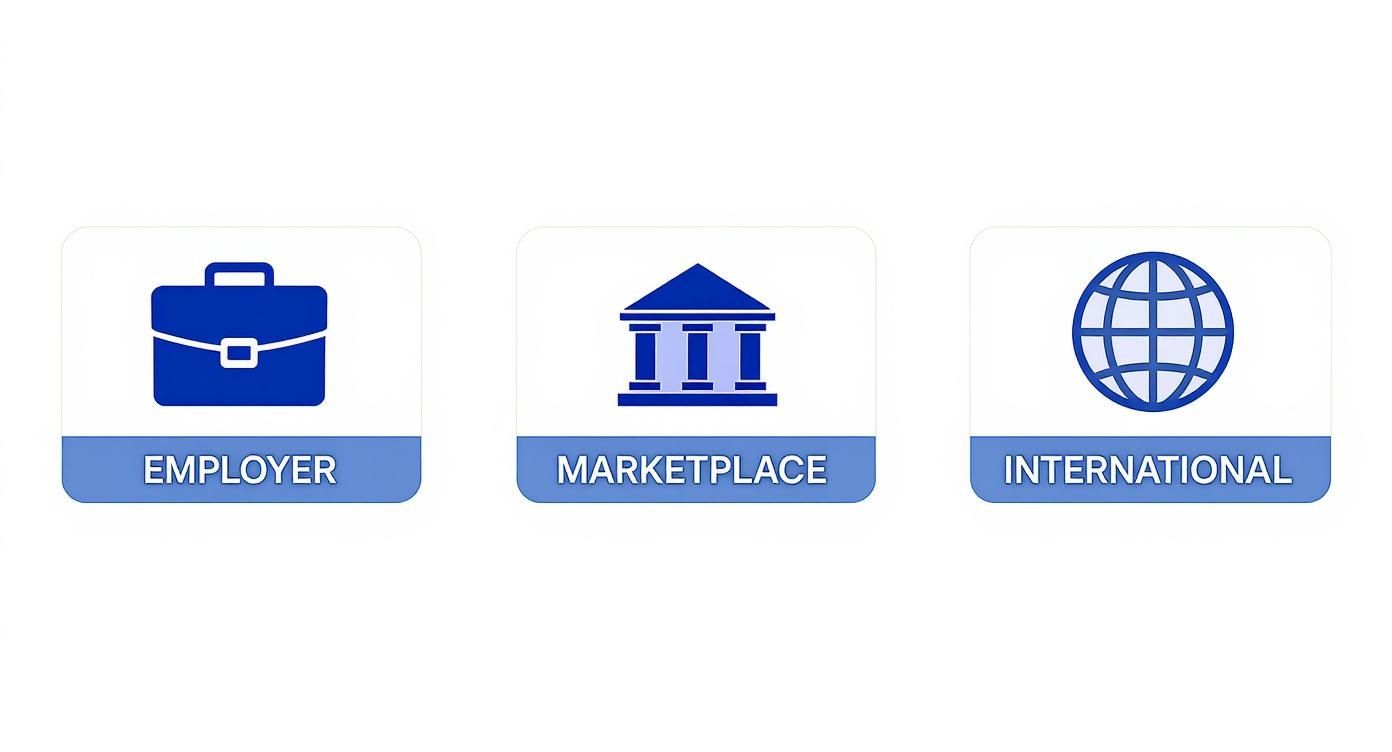
The primary distinction to remember is this: while employer and marketplace plans have rigid enrollment windows, international plans often operate on a more flexible, as-needed basis.
Common Triggers for a Special Enrollment Period
Not every life change will trigger an SEP. The qualifying events are very specific and typically fall into a few key categories. For high-net-worth individuals and expatriates, certain events are particularly critical and require swift action to keep your health and financial portfolio secure.
Common qualifying life events include:
- Changes in Your Household: This is a major category. Marriage, the birth of a child, adoption, or divorce all fundamentally alter your family's health plan requirements.
- Loss of Other Health Coverage: If you or a family member involuntarily loses health coverage—perhaps due to a job change or turning 26 and aging off a parent's plan—you are granted an SEP.
- Changes in Residence: A permanent move to a new ZIP code or county can trigger an SEP, especially if your old plan’s network is no longer available in your new location. For expatriates, moving back to the U.S. after living abroad is a classic qualifying event.
Knowing these triggers enables you to anticipate when you might need to act outside of the standard annual review.
The Critical 60-Day Action Window
Once a qualifying life event occurs, a clock starts ticking. For most of these events, you have a strict 60-day window from the date of the event to select and enroll in a new health plan. If you miss this deadline, you will most likely have to wait until the next open enrollment period, leaving you potentially uninsured.
Consider the 60-day window a non-negotiable deadline. Procrastination can lead to significant financial exposure and gaps in care for you and your family. It requires immediate, decisive action.
To complete the process, you will need to provide documentation to prove your eligibility. The insurance company or marketplace must verify the event before your new coverage can take effect.
Required Documentation for Verification
When applying for a plan during an SEP, be prepared to submit proof of your qualifying life event. The exact documents required will depend on the event, but precision and promptness are essential.
For example:
- For a Marriage: A copy of your marriage certificate.
- For the Birth of a Child: A birth certificate or a hospital record of birth.
- For a Move: Proof of your old and new addresses, such as utility bills or a new lease agreement.
- For Loss of Coverage: An official letter from your previous insurer or employer confirming the exact date your coverage ended.
Gathering these documents in advance will ensure a smooth and efficient enrollment process. By understanding the rules that govern Special Enrollment Periods—the triggers, the deadlines, and the required proof—you can confidently navigate life's changes without ever jeopardizing your family’s access to high-quality healthcare.
Executing Your Open Enrollment Strategy

Allowing your health plan to simply auto-renew is a significant financial oversight. You would not permit your investment portfolio to run on autopilot without an annual review; treat open enrollment with the same strategic diligence. It is a proactive wealth management activity—an opportunity to align your coverage precisely with your life and avoid costly surprises.
This is not a time for passive acceptance; it is a time for active engagement. By systematically evaluating your options, you can avoid overpaying for benefits you will not use or, far worse, finding yourself dangerously underinsured when you need protection the most.
Step 1: Assess Your Prior Year Medical Spend
First, you must conduct a detailed audit of the last 12 months. Do not rely on a vague recollection of your expenditures. Be precise. Gather your explanation of benefits (EOB) statements, pharmacy receipts, and all invoices from physicians and clinics.
Your objective is to create a crystal-clear financial picture. Tally your total out-of-pocket expenses, broken down into these categories:
- Premiums: The fixed monthly cost of your plan.
- Deductibles: The amount you paid before your insurance began to contribute.
- Copayments and Coinsurance: Your share of the cost for appointments, procedures, and prescriptions.
- Out-of-Network Charges: Any funds spent on care outside your plan's approved network.
This retrospective analysis provides a hard data baseline. It reveals exactly how you utilized your plan and where your funds were allocated, which is the only sound foundation for making an informed decision this year.
Step 2: Anticipate Future Healthcare Needs
With a solid grasp of the past, it is time to look forward. The ideal plan for last year could be entirely unsuitable for the year ahead. Consider what may be changing for you and your family.
Are you planning any major medical procedures, such as a joint replacement or corrective surgery? Do you anticipate new specialist visits or ongoing therapies? Are you expecting changes to your prescription medications?
For those living a global life, this step must include forecasting international travel and any potential healthcare needs abroad. Answering these questions helps you model future costs and identify a plan with the right cost-sharing structure and network access, wherever you may be.
Treating open enrollment as an automatic renewal is a significant missed opportunity. Active consumer engagement is essential for both financial wellness and ensuring your coverage remains adequate.
The world of health insurance demands this level of focus. Research shows that employees place a high value on their benefits; a 2023 survey indicated that 84% of employees consider health insurance a key factor in deciding whether to stay at their job. For more insights on making the most of this period, resources from firms like Merative can be incredibly helpful.
Your Annual Open Enrollment Strategic Checklist
To streamline this process, I have developed a checklist. Consider it your guide to systematically reviewing your needs and options, ensuring nothing is overlooked.
| Action Item | Key Considerations | Status |
|---|---|---|
| Review Past Year's Spend | Gather EOBs, receipts, and invoices. Calculate total premiums, deductibles, copays, and out-of-network costs. | ☐ |
| Forecast Upcoming Needs | List planned surgeries, new therapies, or specialist visits. Consider family changes (e.g., pregnancy, dependents). | ☐ |
| Factor in International Travel | Estimate time abroad and potential healthcare needs in other countries. Check for global coverage requirements. | ☐ |
| Scrutinize Plan Changes | Compare new premiums, deductibles, and out-of-pocket maximums to your current plan. Read the fine print. | ☐ |
| Verify Provider Network | Confirm your primary doctor, all specialists, and preferred hospitals are still in-network. This is non-negotiable. | ☐ |
| Check International Network | If you travel, verify that key hospitals and clinics in your frequent destinations are covered. | ☐ |
| Evaluate Prescription Coverage | Ensure your current and anticipated medications are on the new plan's formulary and check their cost tier. | ☐ |
| Assess Tax-Advantaged Accounts | Determine if an HSA-eligible HDHP is a good fit. Plan your maximum contribution for the year. | ☐ |
| Compare Finalist Plans | Run the numbers for 2-3 top plans based on your forecasted needs. Compare total estimated annual costs. | ☐ |
| Submit Your Selections | Actively enroll in your chosen plan. Do not let it auto-renew. Confirm your enrollment is processed. | ☐ |
Use this table each year. It transforms a complex task into a manageable series of steps, ensuring you make a deliberate, informed choice that protects both your health and your wealth.
Step 3: Scrutinize Plan and Network Changes
Never assume your current plan is remaining unchanged. Insurance companies modify their offerings annually. They adjust premiums, deductibles, and out-of-pocket maximums. The changes might appear minor, but they can have a massive impact on your total costs.
Even more critical are the network changes. The most common—and costly—mistake is assuming your trusted physicians and preferred hospitals are still in-network. Networks are dynamic and shift constantly.
Before you commit to a plan, you must verify the network status for:
- Your primary care physician
- All specialists you see regularly
- The hospitals and urgent care centers in your vicinity
- Key providers in any international locations you visit frequently
A health plan is only as good as the doctors and hospitals it provides access to. Confirming your providers are still covered is a non-negotiable step to avoid disastrous surprise bills.
Step 4: Optimize Tax-Advantaged Accounts
Your choice of health plan is directly linked to some of the most powerful financial planning instruments available. If a High-Deductible Health Plan (HDHP) aligns with your risk tolerance and expected medical costs, it unlocks access to a Health Savings Account (HSA).
An HSA offers a rare triple-tax advantage:
- Contributions are tax-deductible, which lowers your current taxable income.
- The funds grow tax-free, compounding year after year.
- Withdrawals are tax-free when used for qualified medical expenses, at any point in your life.
During open enrollment, calculate the maximum allowable HSA contribution for the upcoming year and create a plan to fully fund it. Unlike a "use-it-or-lose-it" Flexible Spending Account (FSA), HSA funds roll over indefinitely. This transforms a simple insurance decision into a savvy, long-term investment for future medical needs and even retirement healthcare costs.
Health Insurance Strategies for Global Lifestyles

For anyone leading a truly global life, relying on a domestic health insurance plan is a fundamental error. These plans are simply not designed for life across borders. If you require seamless, high-quality healthcare wherever you are, you need a different strategy—one that prioritizes global access and continuity of care.
This is where you must shift your thinking away from the rigid calendars of domestic open enrollment. For expatriates, the focus changes to securing international private medical insurance (IPMI). This specialized coverage is not tied to an annual window, providing the flexibility to acquire a policy precisely when your international move requires it. However, this flexibility comes with a different gatekeeper: medical underwriting. It is a process that requires careful planning.
Navigating Underwriting and Pre-Existing Conditions
Unlike ACA plans in the U.S., which are legally mandated to cover pre-existing conditions, international insurers will conduct a thorough review of your medical history. This underwriting process determines your eligibility, your premium, and what, if anything, will be excluded from coverage.
For this reason, it is absolutely critical to secure your international policy before canceling your domestic one.
Taking this step first ensures there are no gaps in your coverage. A new diagnosis that arises while you are uninsured could make it incredibly difficult, or even impossible, to obtain the robust global plan you need. If the timing is mismanaged, you could face permanent exclusions for certain conditions or even be denied a policy altogether.
For a global citizen, the master rule is to treat your health coverage as a continuous, portable asset. Your real "enrollment window" is the entire period leading up to your move abroad. The single most important task is ensuring your coverage for any existing health concerns is never interrupted.
Failing to manage this transition with precision exposes you to massive financial and medical risks. Imagine requiring ongoing care for a chronic condition, only to discover your new international plan will not cover it because you had a two-week gap in coverage during your relocation. It is a catastrophic scenario.
Coordinating Domestic and International Policies
A sophisticated global health strategy involves more than just purchasing a new plan; it requires the artful coordination between your old and new policies to ensure no gaps exist. The good news is that moving abroad is considered a qualifying life event, which triggers a Special Enrollment Period for your domestic ACA or employer plan. This allows you to terminate it without penalty.
The optimal sequence of events is as follows:
- Secure Your International Plan: Apply for and receive full, written approval for your IPMI policy while your domestic coverage is still active.
- Confirm Your Start Date: Align the effective date of your new global plan with your departure date or the exact day your old coverage ends.
- Terminate Domestic Coverage: Use your international move as the official qualifying life event to end your U.S. plan. This prevents you from paying for two policies concurrently.
This careful choreography ensures you are never, not even for a day, without first-rate medical protection. You can gain a much clearer picture of the specific advantages by exploring the many international private medical insurance benefits uncovered in our detailed guide.
Selecting a Plan for a Life Without Borders
Beyond the underwriting process, the criteria for selecting an international plan are entirely different from those for a domestic one. You must focus on features that truly support a mobile, high-stakes lifestyle.
These features should be at the top of your evaluation list:
- A Robust Global Network: Your plan must provide direct-billing access to top-tier hospitals and specialists in the countries where you will live and visit.
- Emergency Medical Evacuation: This is non-negotiable. It is the safety net that ensures you can be transported to a center of medical excellence if local care is not up to standard.
- Portability: The policy must move with you, seamlessly, as you relocate from one country to the next.
To zero in on the right coverage for your life abroad, be sure to consult trusted resources on finding the best expat medical insurance for your life abroad. When you manage your global health portfolio with this level of diligence, insurance ceases to be a mere necessity and becomes a strategic tool for protecting your well-being, no matter where your life takes you.
Costly Mistakes to Avoid During Open Enrollment
Successfully navigating open enrollment means more than just completing a form. It is about sidestepping common traps that can seriously compromise your coverage and your finances for an entire year. Think of it as a critical checkpoint. If you proceed without careful consideration, you are positioning yourself for frustrating—and expensive—surprises.
The single greatest mistake is allowing your current plan to auto-renew without a second thought. Insurers modify their plans annually. Premiums shift, deductibles increase, and, most importantly, the network of physicians and hospitals can change dramatically. What was a perfect fit last year might be a poor one this year, leaving you with unexpected bills or losing access to a trusted doctor.
Overlooking the Total Cost of Care
It is easy to focus exclusively on the monthly premium. This is a classic misstep. A low premium may look attractive, but it often conceals dangerously high out-of-pocket costs that only manifest when you actually use your insurance.
The true cost of any plan is a combination of the premium, deductible, copayments, and the out-of-pocket maximum. To avoid this trap, you must evaluate the complete financial picture:
- Deductible: This is the amount you must pay from your own funds before your insurer begins to contribute to costs.
- Out-of-Pocket Maximum: This figure is your financial safety net. It is the absolute most you will pay for covered medical care in a single year.
In some cases, paying a slightly higher monthly premium can secure a plan with a much lower deductible and out-of-pocket maximum. If you require significant medical care, that decision could ultimately save you a substantial amount of money.
Failing to Verify Your Network
This is perhaps the most damaging mistake of all: failing to confirm that your physicians and hospitals are still in your plan’s network. Provider networks are not static; they change constantly, often without any direct notification to you.
Assuming your trusted physician is still covered is a gamble you cannot afford to take. Verifying your network is not just a good idea—it is an essential step to guarantee you can continue seeing the doctors you rely on and to protect yourself from catastrophic out-of-network bills.
Before you make a final decision, access the insurer's provider directory online. Search for every one of your key doctors, from your primary care physician to any specialists you see regularly. This simple check is the only way to be certain your health plan will function as intended, giving you access to the care you trust without jeopardizing your financial well-being.
Your Open Enrollment Questions, Answered
Let us address the most pertinent questions directly. When it comes to health insurance, a few key inquiries arise consistently. Here are the straightforward answers you need to make informed decisions when it is time to review your coverage.
What Happens If I Miss the Open Enrollment Deadline?
This is a mistake with potentially severe financial consequences.
If you miss the deadline and do not have a qualifying life event that opens a Special Enrollment Period, you are likely locked out of comprehensive health coverage until the following year.
This leaves you and your family completely exposed to America's high medical costs. While you may see advertisements for short-term plans, treat them with extreme caution. They are not a viable solution. These plans offer minimal benefits, almost never cover pre-existing conditions, and are not a substitute for a proper health insurance policy.
Can My Employer Change Our Health Plan Options?
Yes, and you should anticipate that they will. It is a common misconception that your plan will simply roll over unchanged.
Employers constantly review and adjust their benefits packages. This means they can switch insurance carriers, modify premiums, raise deductibles, and—most importantly—change the network of doctors and hospitals available to you.
Actively reviewing your employer's offerings during open enrollment is non-negotiable. It is your only opportunity to adapt to these changes and ensure the plan still aligns with your family's health needs and your financial strategy.
How Do HSAs Work with High-Deductible Plans?
A Health Savings Account (HSA) is one of the most powerful financial instruments available, but it can only be paired with a qualified High-Deductible Health Plan (HDHP).
It offers a rare triple-tax advantage:
- Your contributions are made with pre-tax dollars, lowering your current taxable income.
- The money in the account grows completely tax-free.
- You can withdraw funds tax-free for qualified medical expenses.
An HDHP has lower monthly premiums but requires you to pay more out-of-pocket before the insurance begins to cover costs (the deductible). The HSA is designed to help you meet those costs with tax-advantaged funds. Furthermore, any unused funds simply roll over year after year, making it an excellent vehicle for both healthcare expenses and long-term, tax-free investment.
Navigating the nuances of international health insurance requires specialized expertise. At Riviera Expat, we provide sophisticated guidance to ensure your global health strategy is as robust as your financial portfolio. Discover a clearer path to international medical insurance by visiting us at https://riviera-expat.com.