
When planning a bespoke journey to South Africa, a standard, off-the-shelf travel policy is simply inadequate. A more strategic approach to risk management is required. The right travel insurance to South Africa is not a mere formality; it is a critical component of your wealth protection strategy, securing your health, your investment, and your peace of mind. This guide moves beyond generic advice to address the specific requirements of a high-value itinerary.
Protecting Your South African Itinerary
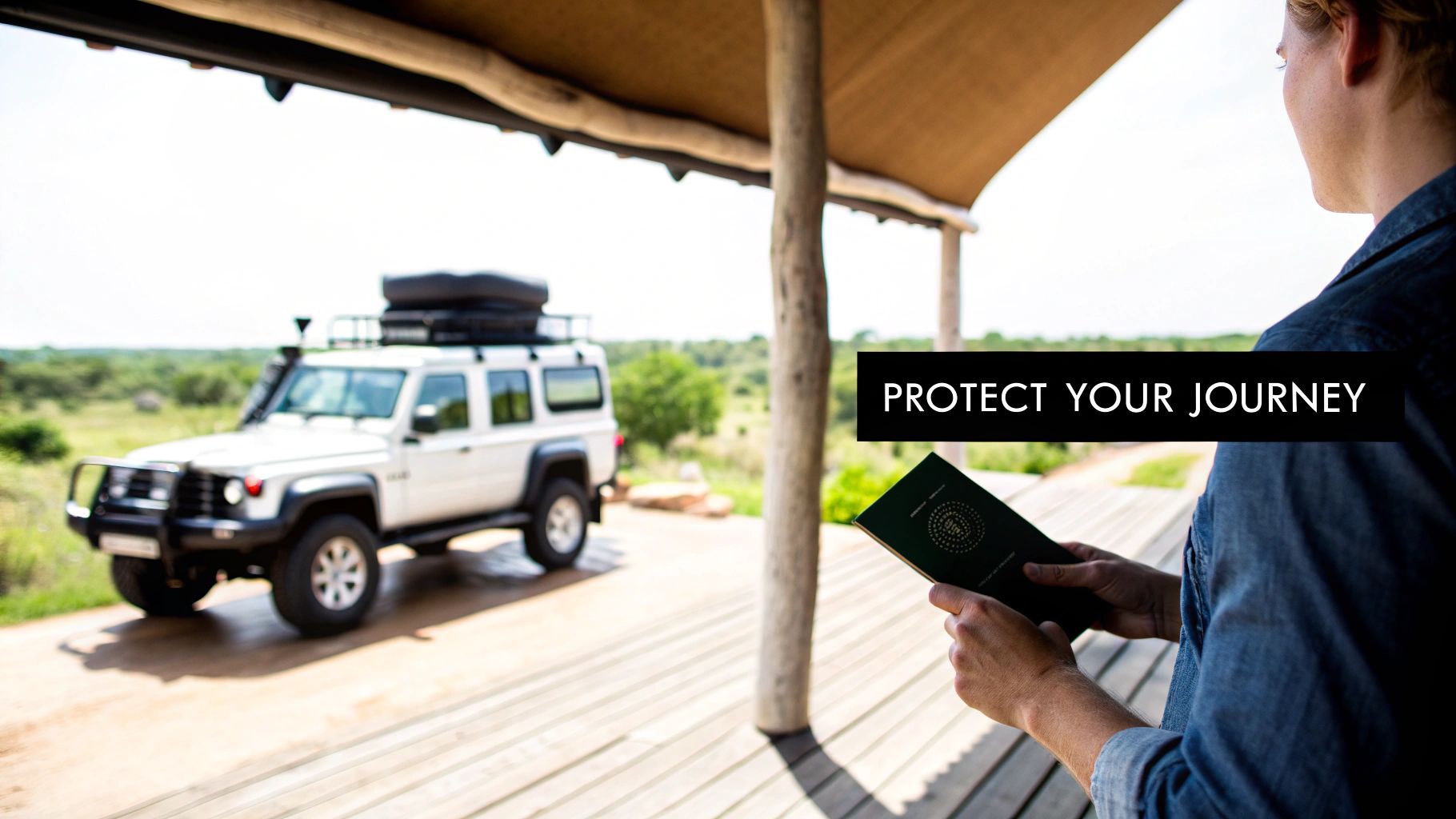
A meticulously planned trip to South Africa involves significant financial commitments. Consider the non-refundable deposits for exclusive safari lodges, private tours through the Cape Winelands, or other unique, high-value experiences. A typical insurance policy will almost certainly fall short, unable to cover the nuanced risks inherent in this caliber of travel. Your journey is an asset; it must be protected as such.
Consider your travel insurance less as a generic product and more as a personalized financial instrument, engineered to defuse specific risks. It stands guard against unforeseen events that could jeopardize your financial well-being. Before delving into policy specifics, it is prudent to gain an understanding of the destination itself—for example, what to expect when you travel to South Africa.
Core Pillars of Essential Coverage
For the discerning traveller, a truly robust policy is constructed upon several key pillars. These elements work in concert to create a seamless shield, protecting everything from medical emergencies in a remote game reserve to your valuable photographic equipment.
Your policy must be built upon these core components:
- High-Limit Medical and Evacuation: This is non-negotiable. It guarantees access to premier private medical facilities and covers the substantial cost of an air ambulance from a remote location to a major city like Johannesburg or Cape Town.
- Comprehensive Trip Cancellation: This protects the significant, non-refundable investment you have made in your itinerary. It serves as your financial backstop should a covered event force a cancellation.
- Specialized Personal Belongings Protection: Standard plans impose unacceptably low limits on personal items. You require a policy that provides adequate coverage for assets such as professional camera equipment, designer luggage, or other luxury goods.
A truly effective travel insurance policy is not reactive; it is proactive. It anticipates the unique challenges of a South African itinerary and provides clear, immediate solutions, ensuring a minor inconvenience does not escalate into a major financial or logistical crisis.
Mastering these foundational elements is the first step toward securing a policy that matches the caliber of your trip. As you evaluate your options, consider how each component integrates into your overall risk management strategy. For broader context on preparing for international travel, our detailed international country guides can offer valuable insights.
Why High-Limit Medical Coverage Is Non-Negotiable
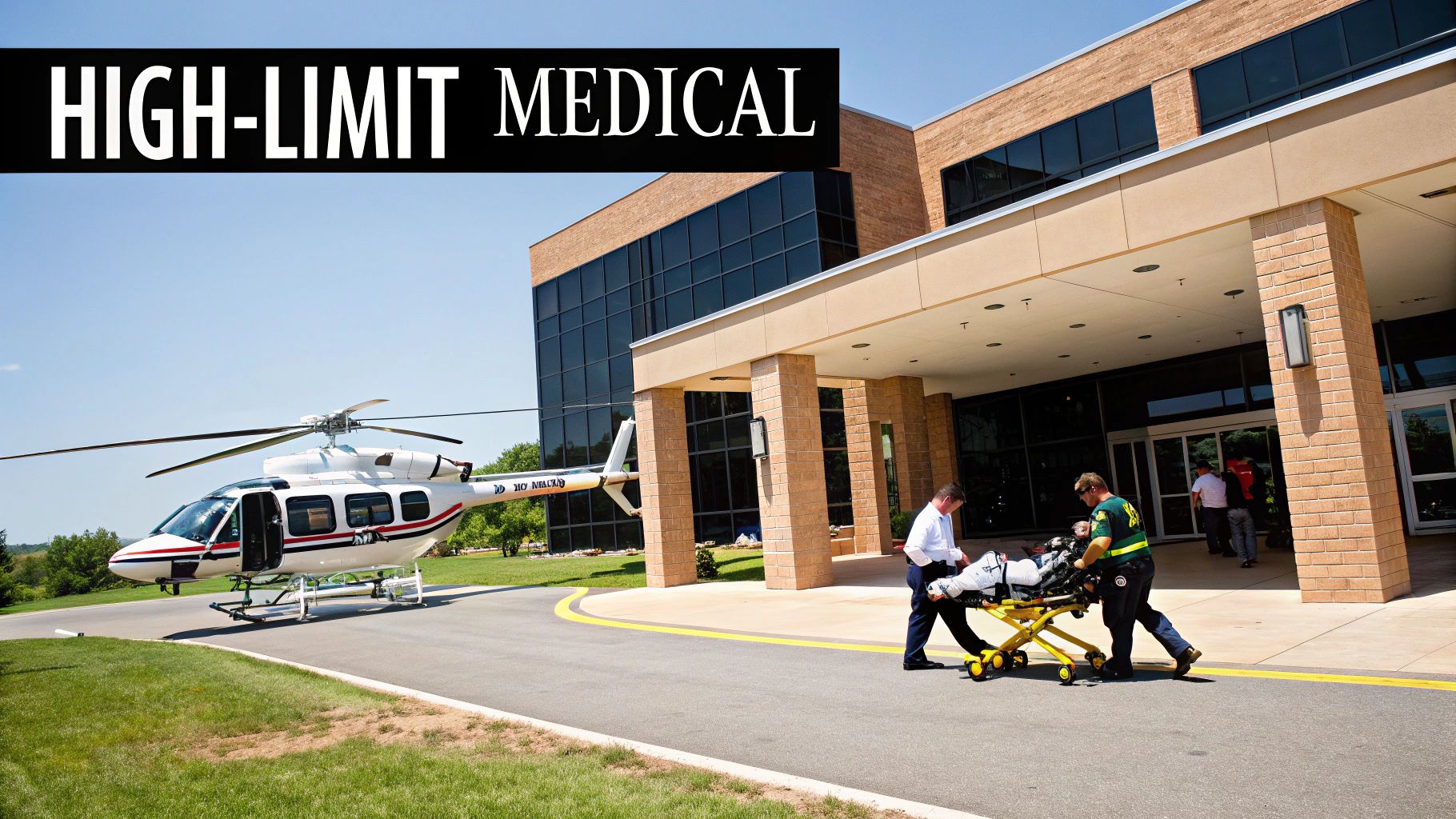
To be clear: treating high-limit medical coverage as an optional extra for a trip to South Africa is a critical miscalculation. The country operates a two-tier healthcare system. For any international visitor, the high-quality private sector is the expected standard of care. However, there is a significant procedural requirement that unprepared travellers often overlook.
The premier private hospitals, particularly in major hubs like Cape Town and Johannesburg, operate as private enterprises. Before conducting a single diagnostic test or administering treatment, they demand one thing: a guarantee of payment. Your domestic health insurance is irrelevant in this context. You must either provide a substantial deposit upfront or possess a travel insurance policy that can immediately guarantee the funds directly to the hospital.
Without that guarantee, treatment will be delayed. It is that straightforward.
The Reality of Medical Costs and Access
Imagine a medical crisis unfolding thousands of miles from your personal physician and financial resources. The very last thing you want is for a financial negotiation to stand between you and essential care. This is precisely why a basic medical benefit on a credit card or a standard travel plan is insufficient.
You require a policy with a direct-payment guarantee. This is a non-negotiable feature. It means your insurer handles all financial arrangements directly with the hospital, removing a crushing logistical and financial burden from you at a time of extreme vulnerability. It is a defining feature of any serious travel insurance to South Africa.
Beyond this, the coverage limit itself is paramount. A $100,000 limit may sound substantial, but a serious accident or illness requiring surgery, an extended ICU stay, and specialist consultations can exhaust that sum within days.
For a journey of this nature, a medical coverage limit of $2,000,000 or more is not an extravagance—it is a baseline necessity. This ensures that any medical intervention, no matter how complex or prolonged, is fully funded without a moment's hesitation.
Medical Evacuation: The Most Critical Benefit
If there is one benefit that defines the value of your policy, it is emergency medical evacuation. South Africa's most memorable experiences—a safari in Kruger National Park, a stay at a secluded lodge in the Sabi Sand Nature Reserve—are often hours away from any top-tier medical facility.
Consider this scenario: a serious injury at a remote safari lodge. A ground ambulance could take hours to navigate difficult terrain. The only viable option for urgent, life-saving care is a private air ambulance—a helicopter or a specially equipped fixed-wing aircraft.
The costs and logistics are formidable:
- Air Ambulance Activation: Mobilizing a medically-equipped aircraft and crew can cost tens of thousands of dollars.
- In-Flight Medical Staff: Specialized physicians and nurses are required to stabilize a patient during transport.
- Logistical Coordination: This involves complex arrangements between the remote location, the aircraft, and the receiving hospital in an urban centre.
A single medical flight from a game reserve to a private hospital in Johannesburg can easily exceed $50,000 to $100,000. If your condition is serious enough to require repatriation to your home country on a medically staffed flight, the costs can escalate into the hundreds of thousands.
This is precisely why a high evacuation limit—ideally $1,000,000 or more—is absolutely essential. It guarantees that should a critical incident occur in the African bush, your policy has the financial capacity to execute a complex, life-saving operation without question. To truly grasp the scope of these protections, you can explore the full benefits of international private medical insurance uncovered in our guide. Ultimately, this level of coverage is not just about financial protection; it is about ensuring access to the best possible care, immediately, irrespective of your location within the country.
Insuring Your Unique South African Itinerary

A trip to South Africa is an active pursuit. Your itinerary is likely filled with once-in-a-lifetime experiences—tracking leopards on a private game reserve, shark cage diving off the coast of Gansbaai, or taking a helicopter over the Drakensberg mountains.
The challenge is that these exceptional activities are often explicitly excluded by standard insurance policies. A basic travel policy is designed for a placid city break, not for the rigours of abseiling down Table Mountain. If an incident occurs during one of these activities, a claim filed without the appropriate coverage will be summarily rejected.
To adequately protect your itinerary, you must augment a generic policy with specific extensions, often called riders. This is not a minor detail; it is a critical step in constructing effective travel insurance to South Africa.
Securing High-Adrenaline Activities
The key to protecting your adventures lies in an adventure sports rider. This is a fundamental add-on that explicitly lists and covers high-risk activities. Without it, you are effectively uninsured the moment you embark on a guided bush walk or a microlight flight.
When reviewing this rider, you must verify two things:
- Is Your Activity Explicitly Listed? Do not accept vague language such as "general sports coverage." The policy must specifically name your intended activities, whether safari drives, scuba diving, or mountain trekking.
- Does It Cover Specialized Rescue? This extends beyond a simple ambulance service. The coverage must account for coordination with remote rescue teams or the deployment of specialized medical equipment to a hard-to-reach location.
A well-structured adventure sports rider functions as a specialist extension of your main medical benefits. It ensures your high-limit medical and evacuation coverage remains in force, even when you are engaged in an activity that would otherwise void a standard policy.
Protecting Your High-Value Personal Effects
Your South African journey may involve travelling with expensive equipment, such as professional-grade camera bodies and lenses for wildlife photography, high-end binoculars, or valuable art acquired during your travels.
Standard baggage coverage is wholly inadequate for these items. Most plans have a low aggregate limit—perhaps $2,500 total—and an even more restrictive single-item limit, often just $250 to $500. This would not begin to cover a $5,000 telephoto lens or a piece of collectible art.
The solution is a personal effects rider with a high single-item limit. This add-on allows you to insure specific items for their appraised value. It ensures that theft or accidental damage does not result in a significant financial loss and is a prerequisite for anyone documenting their trip with professional-grade equipment.
The demand for such tailored, single-trip policies is a notable trend. The travel insurance market in South Africa was valued at USD 412.9 million and is projected to reach USD 1,022.7 million by 2030. Single-trip policies dominate, holding a 61.69% revenue share, driven by leisure travellers undertaking specialized journeys. More data on the South African travel insurance market on Grandview Research is available for review.
This market growth indicates that discerning travellers increasingly recognize the shortcomings of one-size-fits-all coverage. As insurers adapt, it is also crucial that they build strong local partnerships. You can learn more about why robust international medical networks are so important in our detailed guide. Tailoring your policy with these riders is the only way to ensure that every facet of your curated South African experience—from the adventures undertaken to the equipment carried—is properly protected.
Understanding Trip Cancellation and Interruption Insurance
A meticulously planned journey to South Africa represents a significant financial commitment. The non-refundable deposits for exclusive safari lodges, private charter flights, and unique guided experiences accumulate rapidly. Standard trip cancellation insurance provides a baseline safety net for specific, unforeseen events like a sudden illness or a death in the family, but it operates from a very rigid list of "covered reasons."
For a high-value, complex itinerary, this is often insufficient. You require a level of flexibility that mirrors your investment. What if a critical business imperative shifts or a personal situation arises that is not on the insurer's pre-approved list? With a standard policy, you would likely forfeit every dollar prepaid.
Going Beyond Standard Protection with CFAR
For ultimate control over your travel investment, the 'Cancel for Any Reason' (CFAR) rider is the definitive solution. This is not a standalone policy but a powerful upgrade to a comprehensive travel insurance plan. It permits you to cancel your trip for any reason whatsoever and still recover a significant portion of your non-refundable costs.
Consider it the difference between a non-refundable economy ticket and a fully flexible first-class fare. A standard policy dictates the terms, but a CFAR rider returns the decision-making power to you.
A CFAR add-on is a strategic financial tool. It transforms your travel insurance from a simple reactive shield into a proactive asset, acknowledging that life is unpredictable and providing a clear mechanism to manage financial risk on your own terms.
This level of flexibility is subject to certain conditions. Insurers typically require you to purchase the CFAR rider within a short window after your initial trip payment, usually 14 to 21 days. Furthermore, the reimbursement is not 100%; it generally covers between 50% and 75% of your insured, non-refundable trip costs.
For high-value travel, it is crucial to understand how these two types of cancellation coverage differ in practice.
Comparing Cancellation Coverage Options
| Feature | Standard Trip Cancellation | Cancel for Any Reason (CFAR) Add-On |
|---|---|---|
| Covered Events | Only a specific, limited list of unforeseen events (e.g., serious illness, death in family, jury duty). | Literally any reason you choose—work conflict, change of plans, or simply a change of mind. |
| Reimbursement | Typically 100% of your insured, non-refundable trip costs. | Usually 50% to 75% of your insured, non-refundable trip costs. |
| Flexibility | Highly restrictive. The reason for cancellation must be on the insurer's approved list. | Complete flexibility. The decision to cancel is entirely yours, no justification required. |
| Best For | Lower-cost, straightforward itineraries where the likelihood of non-covered cancellation is low. | High-investment, complex trips where personal or professional flexibility is paramount. |
The conclusion is clear: while standard cancellation offers full reimbursement for a narrow set of problems, CFAR provides a substantial safety net for an infinite number of scenarios, which is often the more prudent choice for protecting a significant financial outlay.
A Practical Scenario for CFAR
Imagine you have booked a multi-generational family safari costing $80,000. The price includes non-refundable payments for a private villa, chartered bush flights, and exclusive-use game drive vehicles. Two weeks before departure, a critical business negotiation requires your presence—a situation not covered by a standard policy.
- Without CFAR: You would forfeit the entire $80,000.
- With a 75% CFAR rider: You would recover $60,000, reducing your loss to a far more manageable $20,000.
This example perfectly illustrates how CFAR functions as an essential financial backstop for complex, high-investment travel.
Navigating Trip Interruption
Equally important is trip interruption coverage. This benefit activates after your journey has commenced. If a covered emergency, such as a medical crisis in your family, forces you to curtail your trip, this coverage intervenes.
A quality policy will manage the substantial costs and logistical complexities of an emergency return. This includes booking last-minute, one-way flights at premium rates and reimbursing you for the unused, non-refundable portions of your trip, such as the remaining nights at your safari lodge.
A growing awareness of these risks is driving insurance adoption across Africa. For instance, private healthcare for a serious accident can easily exceed USD 50,000, and flight disruptions are a persistent concern. For US travellers, who make over 500,000 visits to South Africa annually, policies often include specific health-related clauses, with insurance claims for health issues increasing by 30% in a recent year. You can explore more African travel insurance market trends at Next MSC. This data underscores why robust interruption benefits are a non-negotiable component of any serious travel insurance to South Africa.
How to Select the Right Policy for Your Trip
Selecting the right travel insurance is a strategic decision, not a simple purchase. It demands a rigorous analysis of your itinerary and personal risk profile to ensure the procured coverage aligns with the realities of your journey. An ill-fitting policy is nearly as detrimental as having no policy at all.
Your first step is to establish the non-negotiables. For a trip to South Africa, certain core benefits form the absolute foundation of your protection. Anything less introduces an unacceptable level of financial and personal risk.
Your Core Coverage Checklist
Before comparing providers, evaluate any potential policy against this checklist. Consider it your first line of defense—if a policy fails on any of these points, it is unsuitable for South Africa.
- High-Limit Medical and Evacuation: The policy must offer at least $2,000,000 in medical benefits and a minimum of $1,000,000 for medical evacuation. There are no exceptions.
- Direct-Pay Provisions: It must explicitly state that the insurer will guarantee payment directly to private South African hospitals. This is critical to avoid treatment delays.
- Appropriate Activity Riders: Verify that every planned activity—from safari game drives to shark cage diving—is specifically named and covered, likely under an adventure sports add-on.
- Comprehensive Cancellation Benefits: Your policy must protect the full, non-refundable cost of your trip. For maximum flexibility, ensure a 'Cancel for Any Reason' (CFAR) rider is available.
This decision tree provides a simple framework for considering one of the most important add-ons for a high-value trip: cancellation insurance.

As illustrated, the greater the financial commitment in non-refundable bookings, the more a CFAR rider becomes a prudent risk management tool rather than a mere expense.
The Claims Process Demystified
Should the need arise to utilize your insurance, the process must be swift and efficient. The true test of a policy is not at the point of purchase, but at the time of claim. You require a provider that offers 24/7 global assistance services staffed by experienced professionals.
In a true medical emergency, your first call should be to your insurance provider's assistance line—even before contacting family. These are the professionals equipped to coordinate logistics, guarantee payments to hospitals, and manage a medical evacuation. They are your critical support system on the ground.
Preparation is paramount. Maintain digital and physical copies of all key documents: policy details, emergency contact numbers, receipts for trip payments, and any medical reports. Thorough documentation is the key to a seamless claims process, ensuring prompt and complete reimbursement. For more general guidance on how to pick a travel insurance policy, other resources may also prove useful.
A Strategic Evaluation Framework
Once you have confirmed the fundamentals are in place, you can begin to compare policies with analytical rigour. Look beyond the premium and examine the specific terms and limits. Familiarize yourself with the policy wording, especially concerning definitions and exclusions for items such as pre-existing medical conditions or "high-risk" activities.
Pose precise questions. How does the insurer define a "reasonable" expense in the event of trip interruption? What is the exact procedure for a medical evacuation from a remote safari lodge? A top-tier provider will have clear, unambiguous answers. This level of scrutiny ensures the travel insurance to South Africa you select is more than a document—it is a reliable partner prepared to protect your journey.
Frequently Asked Questions
When planning an itinerary for South Africa, several key questions about travel insurance invariably arise. Obtaining clear, precise answers is essential to constructing a protection strategy commensurate with the quality and complexity of your journey.
Is Travel Insurance Mandatory for South Africa?
While South Africa does not have a federal mandate requiring all tourists to present proof of travel insurance upon entry, for all practical purposes, it is absolutely essential. The operational reality on the ground is what dictates necessity.
The country's premier private hospitals—the facilities you would insist upon in an emergency—operate on a strict "payment-first" model. Before admission or the commencement of any significant treatment, they require a definitive guarantee of payment.
Without a robust insurance policy that provides this direct-payment guarantee, you are placed in a precarious position. You could face dangerous delays in receiving care or be compelled to provide a massive deposit, often tens of thousands of dollars, via credit card. Therefore, while not a visa requirement, it is an operational necessity for accessing high-quality medical care in a timely manner.
What Is a Sufficient Medical Evacuation Limit?
For a destination like South Africa, where many of the most compelling experiences are in remote locations, a high medical evacuation limit is not an optional luxury; it is non-negotiable. I consider $1,000,000 the absolute minimum, but for genuine peace of mind, a policy providing $2,000,000 or more is the prudent choice.
This figure is based on the staggering real-world costs of a complex medical crisis far from a major urban centre.
- Initial Response: Coordinating a private air ambulance from a remote game reserve to a world-class hospital in Johannesburg or Cape Town can easily exceed $50,000.
- Medical Repatriation: If your condition requires a medically supervised flight back to your home country, the costs can escalate into the hundreds of thousands of dollars.
Underinsuring this single benefit is one of the greatest financial risks a traveller can assume. It is the critical safety net that ensures geography does not preclude access to immediate, world-class medical attention.
A policy with an inadequate limit could leave you with a life-altering financial liability for the very service designed to save your life. The risk is simply not worth taking.
Does My Premium Credit Card Insurance Offer Enough Protection?
The answer is almost certainly no. The travel insurance included with premium credit cards is a valuable benefit, but it is designed as a secondary layer of protection, not as a primary instrument. For a significant, multi-faceted journey to South Africa, these plans have critical deficiencies.
They almost invariably feature:
- Lower Coverage Limits: Their medical and evacuation limits are often a fraction of what a standalone policy provides, sometimes capped at an insufficient $50,000.
- Limited Scope: They rarely cover adventure sports, a disqualifying exclusion for any active South African holiday.
- Exclusion of Key Add-Ons: You will almost never find powerful benefits like 'Cancel for Any Reason' (CFAR) available as an option.
Consider your credit card's travel insurance a supplementary benefit. It may be useful for minor inconveniences, but it lacks the financial capacity and specialized coverage required to protect a major investment or manage a true medical crisis in South Africa.
Can I Purchase Insurance After My Trip Has Started?
In almost all circumstances, no. The vast majority of comprehensive travel insurance policies, particularly those including trip cancellation benefits, must be purchased prior to departure. This is because the insurer's risk commences from the moment of purchase, protecting you from unforeseen events that could force a cancellation before your journey begins.
A few niche providers offer "already travelling" policies, but they come with significant limitations. They typically impose mandatory waiting periods of 24 to 72 hours before key benefits, like medical coverage, become active. More importantly, they will never cover trip cancellation for funds already expended.
The only sound strategy is to secure your travel insurance to South Africa before you leave home. It is the only way to guarantee seamless, end-to-end protection for every component of your journey, ensuring your financial investment is secure from day one.
Navigating the world of international medical and travel insurance can be a complex undertaking. At Riviera Expat, we specialize in providing clear, expert guidance to help you select a policy that perfectly matches the demands of your itinerary and lifestyle. Our proprietary comparison engine and white-glove service approach remove the guesswork, ensuring you have complete confidence in your coverage. Discover a better way to secure your global health and travel protection by visiting us at https://riviera-expat.com.