
An insurance rider policy is not a separate, standalone product. It is a strategic enhancement to your primary international private medical insurance (IPMI) plan.
Consider it a specific clause added to your policy, designed to integrate high-value benefits that your core plan does not cover. This is how you create genuinely bespoke protection, ensuring your coverage is an exact match for your global lifestyle and the unique risks you face.
Customizing Your Global Protection Beyond a Standard Policy
For individuals with significant international assets and responsibilities, a standard, off-the-shelf insurance policy represents a considerable vulnerability. While it provides a basic layer of security, its 'one-size-fits-all' approach often leaves substantial gaps when confronted with the complex realities of an international life.
Relying solely on a base policy is a serious oversight. It can lead to severe financial exposure and suboptimal care precisely when you need it most. This is where the strategic application of an insurance rider becomes non-negotiable.

The Analogy of Bespoke Tailoring
Imagine your standard insurance policy as a high-quality, off-the-rack suit. It is well-made and serves its purpose adequately for most situations. However, for a perfect fit shaped to your exact physique and preferences, you require a master tailor.
An insurance rider is that master tailor. It executes the custom alterations—adding coverage for specific medical needs, expanding your geographic limits, or enhancing certain benefits—that transform a generic policy into a perfectly fitted garment of protection.
These are not frivolous add-ons; they are critical components of a robust health and wealth protection strategy. For instance, your base policy might cover a general hospital stay, but it will likely not cover a medical evacuation from a remote location or grant you access to a world-class specialist for a rare condition. You can gain a better understanding of the fundamentals in our guide to international private medical insurance benefits uncovered.
Reframing Riders as Essential Instruments
It is easy to view riders as optional extras, but this is a flawed perspective. For a discerning individual, they are strategic instruments designed to mitigate specific, foreseeable risks that standard policies intentionally exclude to maintain lower costs.
Forgoing a critical rider is akin to building a fortress but leaving a side gate entirely unguarded.
By carefully selecting the right riders, you elevate your coverage from a generic safety net to a proactive defense mechanism. This ensures your protection is as dynamic and sophisticated as your personal and professional life demands, providing genuine peace of mind, no matter where your ventures take you.
To illustrate the difference, here is a high-level comparison of a standard policy versus one enhanced with carefully selected riders.
Standard IPMI vs. Rider-Enhanced Policy
| Coverage Area | Standard Policy Scope | Enhanced Policy Scope With Riders |
|---|---|---|
| Medical Evacuation | Basic coverage, often limited to the nearest "adequate" facility. | Comprehensive evacuation to a designated center of excellence or home country. |
| Maternity Care | Typically excluded or subject to long waiting periods. | Full coverage for pre-natal, delivery, and post-natal care. |
| Dental & Vision | Excluded. | Routine and major dental/vision care included up to specified limits. |
| Mental Health | Limited inpatient coverage, minimal outpatient support. | Robust coverage for therapy, counseling, and psychiatric care. |
| Deductibles | Fixed, often high, out-of-pocket costs before coverage activates. | Reduced or eliminated deductibles via a buy-down rider. |
| Pre-existing Conditions | Excluded. | Potential coverage via a specific waiver rider (underwriting dependent). |
| Catastrophic Events | Standard policy limits apply. | Added lump-sum benefits for specified critical illnesses or accidental death. |
As you can see, riders fundamentally alter the nature of your protection, closing dangerous gaps and transforming a basic plan into a comprehensive shield. They are the key to building a truly robust IPMI solution.
Understanding How an Insurance Rider Works
An insurance rider is best understood as a specialized, legally binding upgrade to your core insurance contract. It is analogous to commissioning a bespoke performance package for a luxury automobile. The base model is superb on its own, but adding specific enhancements—for superior handling, advanced safety systems, or exclusive comforts—transforms it into a machine perfectly tuned to your exact requirements.
In the same way, a rider does not exist in a vacuum; it is fundamentally attached to your primary policy. This is a critical distinction. Its sole purpose is to add specific benefits, modify the terms, or waive certain exclusions found in the standard agreement. The end result is a more robust and personalized shield of protection.
The Contractual Relationship
A rider and its base policy are indivisible. You cannot procure a rider as a standalone product. Its legal validity is entirely contingent on the main policy remaining active and in good standing.
If your core insurance policy is terminated for any reason, all attached riders are simultaneously nullified. This integrated structure ensures the enhancements are always part of a comprehensive strategy, not fragmented add-ons.
Understanding this structure is the first step to unlocking its strategic power. It also means you must read the rider's terms in conjunction with the main policy document. To build a solid foundation, you can learn more about interpreting key terminology in our guide explaining expat medical insurance policy terms.
Underwriting and Financial Integration
When you request an insurance rider, it triggers a specific underwriting process. Insurers are not merely stamping a document; they are meticulously assessing the additional risk associated with the enhanced coverage you desire. This detailed risk evaluation directly influences your total premium.
This process has established riders as a major driver of product customization in global insurance markets. For example, recent industry analysis indicates that in the United States, a significant portion of new individual life policies now include at least one rider. These additions typically add 2% to 15% to a policy’s premium, depending on the risk covered and your personal profile. You can explore more about these global insurance trends on McKinsey.com.
The cost of a rider is calculated and integrated directly into your main policy's premium, usually appearing as a distinct line item. This provides complete transparency regarding what you are paying for core coverage versus the specialized enhancements you have chosen, creating a single, seamless agreement built for you.
Essential Riders for the Globally Mobile Individual
For a globally mobile professional, a standard insurance policy is merely the starting point—the foundation, not the complete structure. True security, the kind that affords peace of mind regardless of your time zone, is achieved by strategically adding riders that address the unique, high-stakes risks of an international life.
These are not superficial add-ons but specialized instruments. An insurance rider transforms a generic safety net into a shield custom-forged for your life. Rather than simply listing options, let us examine these riders as solutions to the real-world challenges that high-net-worth expatriates frequently encounter. Each one closes a specific, and often substantial, gap left open by a standard IPMI plan.

Medical Evacuation and Repatriation
Imagine suffering a sudden cardiac event or a serious accident while traveling in a country with questionable medical facilities. Your standard policy might cover transport to the "nearest adequate facility," but that term is dangerously ambiguous, and their definition of "adequate" may be vastly different from yours. This is precisely where a Medical Evacuation and Repatriation rider becomes invaluable.
This rider performs one function, and it does so exceptionally well: it transports you to a top-tier medical center, swiftly. It covers the cost of medically necessary transport, often by a private air ambulance, to a hospital of your choice or back to your home country.
This is about more than logistics; it is about control. It ensures a medical emergency in a remote corner of the world does not compel you to compromise on world-class care, protecting both your health and your peace of mind.
Critical Illness Rider
A diagnosis of cancer, stroke, or heart disease changes your world in an instant. While your core IPMI plan will manage the direct medical bills, it does nothing to address the significant financial repercussions that follow. This includes lost income, travel expenses for second opinions with world-leading specialists, or experimental treatments not yet covered by standard insurance.
The Critical Illness rider is your financial first responder. Upon diagnosis with a specified condition, it pays out a pre-agreed, tax-free lump sum.
This capital injection provides you with options and financial latitude. You can use it to:
- Consult with the world's best specialists, without concern for whether they are "in-network."
- Cover your mortgage and living expenses, allowing you to focus entirely on your recovery.
- Pay for cutting-edge treatments that may not be approved or covered by your main policy.
In short, this rider prevents a health crisis from becoming a financial catastrophe. It empowers you to make decisions based on what is best for your health, not merely what is covered.
Pre-existing Condition Waiver
For many expatriates, a pre-existing condition is the greatest obstacle to securing robust international health coverage. Standard policies almost invariably exclude them, leaving a large, predictable vulnerability in your financial protection.
A Pre-existing Condition Waiver rider is a highly specialized solution that requires intensive underwriting. It is designed to bring a known medical condition under the umbrella of your coverage, following a detailed risk assessment by the insurer. Securing one demands complete transparency during your application, but the benefit is immense. It closes what might be your single greatest medical and financial risk while living abroad.
Dental and Vision Coverage
Most people consider dental and vision care "routine," but the costs can be substantial. Complex procedures such as orthodontics, dental implants, or corrective eye surgery can amount to tens of thousands of dollars. To maintain lower base premiums, standard IPMI plans almost always exclude this coverage.
A Dental and Vision rider closes this gap by integrating this essential care into your policy. It covers a broad range of services, from regular check-ups to major restorative work. For expatriate families, this rider is a game-changer, guaranteeing access to top-quality orthodontic and preventative care for your children without facing prohibitive out-of-pocket expenses. It is a practical, intelligent addition that addresses a very common and costly aspect of your family’s well-being.
Comprehensive Mental Health Coverage
The pressures of a global career can take a serious toll. Yet many standard insurance policies provide remarkably poor mental health coverage, often limited to inpatient stays only. This leaves a critical gap in support for services such as therapy and counseling.
A Mental Health rider is structured to provide serious, comprehensive support for your psychological well-being. This add-on typically provides broad coverage for:
- Outpatient therapy and counseling sessions with psychologists or psychiatrists.
- Inpatient treatment for more severe conditions.
- Access to wellness applications and other mental health support tools.
This rider is a recognition that your mental health is as important as your physical health. It ensures you and your family can access confidential, high-quality care whenever needed, without question. Each of these riders serves a clear, strategic purpose, allowing you to build an insurance policy that truly reflects your personal needs and global lifestyle.
The Financial and Underwriting Implications of Riders
Adding a rider to your policy is not a simple checkbox exercise. It is a serious financial decision that initiates a detailed risk assessment by your insurer, a process known as underwriting. The insurer is not merely adding a new benefit; they are fundamentally altering their financial exposure, and your premium will be recalibrated to reflect this change.
This price adjustment is implemented through actuarial loading. Insurers use complex models to quantify the additional risk a rider introduces. They will analyze your age, health status, medical history, and even your countries of residence and travel. A request for a mental health rider, for example, triggers a completely different set of inquiries than one for basic dental coverage.
Consider actuarial loading as the insurer’s method for pricing a specific risk. A standard, low-risk rider might add a predictable, almost off-the-shelf cost to your premium. However, a highly personal rider, such as a waiver for a pre-existing condition, demands a bespoke underwriting process, often resulting in a more significant and carefully calculated premium increase.
Understanding this is key to conducting a clear-eyed cost-benefit analysis for any rider you are considering.
How Underwriting Shapes Your Premium
The underwriting for a rider can be as rigorous as that for your main policy. If you are requesting something complex like a pre-existing condition waiver, expect the insurer to require detailed medical records and physician's notes. This is because you are asking them to cover a known risk, not just a statistical probability, which fundamentally changes their assessment.
You can learn more about how insurers handle these situations by understanding their approach to medical conditions and policy exclusions.
The outcome of this process directly impacts your premium. Here’s how different riders can vary in cost:
- Standardized Riders: Coverage for dental and vision is typically priced based on broad demographic data. The premium increase is relatively predictable and consistent for individuals of a similar age and location.
- High-Risk Riders: A medical evacuation rider for someone who spends significant time in remote or unstable regions will carry a much higher price tag than for someone based in a major European city.
- Condition-Specific Riders: The cost for a pre-existing condition waiver is entirely personalized. It is calculated based on the specific condition, its stability, and the potential for long-term treatment costs.
The Broader Financial Picture
Riders do not just increase your premium; they alter the entire financial dynamic of your insurance for both you and the insurer. Industry reports from firms like EY show that value-added options can increase a policy’s annual premium by 10% to 35%. Some high-cost riders, such as long-term care, can increase premiums by 50% or more, particularly for older applicants.
For the insurer, riders may enhance client retention, but they also complicate their financial models. For example, accelerated benefit riders mean they may have to pay out large sums sooner than anticipated, which reshapes their cash flow and reserve obligations.
This is precisely why a candid discussion with your advisor is non-negotiable. By understanding how each potential rider impacts both the underwriting process and the final cost, you can ensure your investment in additional coverage aligns perfectly with your protection strategy and budget.
A Strategic Framework for Selecting Your Riders
Choosing the right insurance riders is not about ticking boxes on a generic checklist. It is about moving beyond one-size-fits-all advice to construct a layer of protection that mirrors your unique global life. The objective is to design a highly customized, cost-effective insurance plan that mitigates your specific vulnerabilities without compelling you to pay for coverage you will never use.
This process always begins with a frank assessment of your personal needs. It involves evaluating your family’s medical history, the quality of healthcare where you reside and travel, and how these various elements integrate into your long-term financial plan. An off-the-shelf policy is inadequate for a life lived across borders; your protection must be built for purpose.
This decision flow provides a starting point for considering whether to enhance a standard policy with riders.
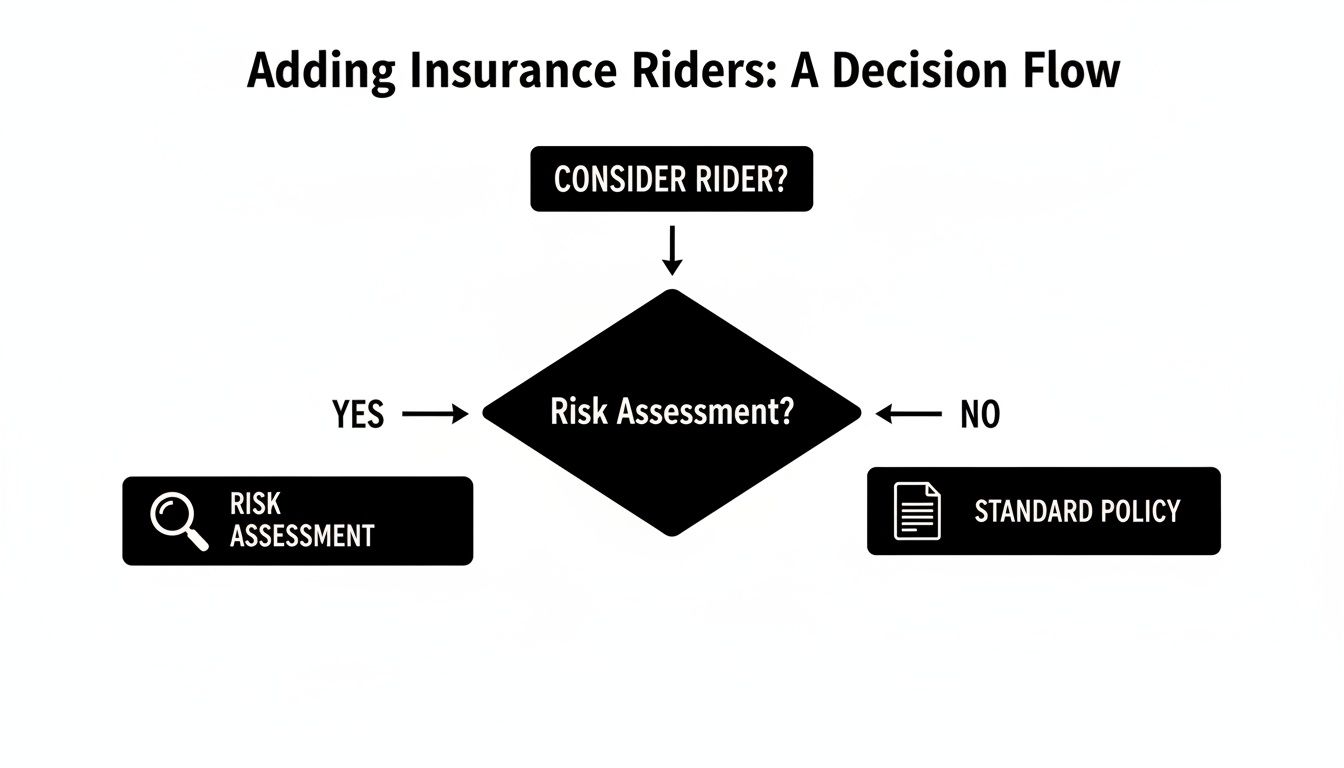
The key takeaway here is that a deliberate, personal risk assessment is what separates a standard plan from one that is strategically fortified with the right riders.
Personal Risk Assessment
The first step is to conduct a detailed inventory of your potential risks, examining your health, lifestyle, and geography. Consider this a self-audit—it will form the foundation of your rider strategy, ensuring every decision is driven by reality, not assumptions.
Start by asking some incisive questions:
- Family Medical History: Does our family have a history of cancer, heart conditions, or other serious hereditary illnesses? This is a direct indicator of whether a Critical Illness rider is a prudent investment.
- Geographic Exposure: Will I be spending significant time in remote areas or in countries with questionable medical care? If so, a robust Medical Evacuation rider becomes non-negotiable.
- Lifestyle and Dependents: Are we planning to start or grow our family soon? A comprehensive Maternity rider is essential. Do my children require orthodontics? A Dental and Vision rider immediately becomes a priority.
Aligning Coverage with Financial Objectives
Your insurance strategy should integrate seamlessly into your broader wealth management plan. The true goal is to use riders not just as a safety net, but as an instrument to preserve your capital by preempting the catastrophic financial shock of an unexpected health crisis.
A well-chosen insurance rider policy acts as a financial firewall. It ensures a medical emergency does not derail your long-term wealth objectives by forcing you to liquidate assets to cover massive, unforeseen bills.
Consider the financial damage a major health event could inflict without the right protection. The cost of a single international medical evacuation can easily exceed $100,000, while specialized cancer treatments can escalate into the millions. A rider transfers this enormous financial risk from your personal balance sheet to the insurer's for a predictable, manageable premium.
The Role of a Specialized Broker
Navigating the complexities of an insurance rider policy is not an endeavor you should undertake alone. The nuances of underwriting, the critical details within policy documents, and the sheer volume of options demand expert guidance. A specialized broker who serves clients like you is an invaluable asset.
An experienced broker acts as your advocate, utilizing their deep market knowledge to:
- Identify the right insurers who have a proven track record of managing complex risks for global citizens.
- Negotiate superior terms and premiums on your behalf, ensuring you receive the absolute best value.
- Translate the fine print, converting confusing policy jargon into clear, actionable insights so you understand precisely what is covered—and more importantly, what is not.
Working with a specialist transforms the rider selection process from a challenge into a structured, strategic exercise that results in a truly bespoke and effective protection plan.
Getting Your Policy Right: The Acquisition Process
Acquiring a sophisticated international health plan with riders is not like purchasing a product off a shelf. It is a strategic process where success hinges on two elements: complete transparency and partnership with a professional who truly understands the landscape for high-net-worth expatriates. Your first action should always be to engage a top-tier broker. They are your single most important ally.
These advisors do more than just shop for quotes. They become your advocate, navigating complex underwriting rules and translating dense policy documents into plain English. Their true value is most apparent when dealing with sensitive topics like pre-existing conditions, where anything less than 100% transparency is a recipe for future complications.

Full Disclosure Is Non-Negotiable
To be direct: the validity of every future claim rests on the accuracy of the information you provide upfront. Attempting to conceal or downplay a pre-existing condition is a catastrophic error. It is the surest way to have a claim denied and your policy rescinded at the very moment you need it most.
Full disclosure is not a bargaining chip; it is the foundation of a valid contract. It allows the insurer to price the risk accurately, guaranteeing the policy you sign is a dependable safety net, not a tenuous agreement.
This transparency provides the underwriter with all necessary information to construct a solid policy, protecting both your financial investment and your future access to quality care.
Scrutinizing the Fine Print and New Regulations
Once an insurer drafts a policy, the detailed work begins. You and your broker must review every clause of each insurance rider policy with meticulous attention. You are looking for hidden exclusions, subtle limitations, or unexpected waiting periods. Before any procedure, it is critical to understand how to verify your insurance for treatment to manage expectations and avoid financial surprises.
The positive news is that regulators are beginning to enforce greater clarity. Over the past decade, international watchdogs have pushed for increased transparency in how riders are sold and priced. In major markets like the EU and UK, consumer protection laws now mandate that insurers provide simple, standardized summaries. These documents must clearly detail rider costs and illustrate exactly how they affect your benefits—a positive trend that is prompting major insurers to release new, clearer templates between 2024 and 2025.
This Isn't a "Set It and Forget It" Strategy
Your life is not static, and your insurance should not be either. An annual review of your policy and its riders is a fundamental part of responsible financial management. A major life event—the birth of a child, a move to a new country, or the launch of a new business venture abroad—absolutely necessitates a corresponding update to your coverage.
This yearly check-in ensures your protection keeps pace with your life, preventing dangerous gaps from emerging. It shifts your insurance from being a static purchase to a dynamic, living strategy that actively safeguards your health and wealth, regardless of where your journey leads.
Frequently Asked Questions About Insurance Riders
Navigating insurance riders invariably raises practical questions. When making decisions about your global protection, you require absolute clarity on how these add-ons function in practice. Here are some of the most common questions we receive from clients, answered directly.
Can I Add a Rider at Any Time?
This is a common misconception, but the answer is almost always no. You cannot simply add a new rider whenever a new need arises mid-year.
The vast majority of riders must be selected when you first initiate the policy or during your annual renewal period. This is because adding a rider alters the insurer's risk, which necessitates a fresh underwriting assessment. Consider it analogous to adding a sunroof to a car after it has already left the factory—it is a fundamental modification, not a simple accessory swap. The best practice is to anticipate future needs and construct your ideal coverage structure from the outset.
Are All Insurance Riders Worth the Cost?
There is no universal answer here. The value of a rider is entirely personal and depends on a straightforward cost-benefit analysis for your life.
For one individual, a medical evacuation rider is a non-negotiable component of their global safety net. For another who rarely leaves major urban centers, it might be an expensive add-on they will never use. The essential question is: does the premium you pay transfer a significant, foreseeable financial risk from you to the insurer?
A skilled advisor can help you navigate this. They will assist you in distinguishing between riders that provide mission-critical protection and those that may seem appealing but offer little practical value for your unique situation.
How Does a Rider Claim Affect My Policy?
When you make a claim under a rider, it is adjudicated according to that rider's specific terms, not the main policy's. The impact on your core coverage depends entirely on which rider has been utilized.
For example:
- No Impact: Filing a claim under a dental, vision, or routine mental health rider typically has no effect on your main policy's benefit limits or premiums. These are self-contained benefits.
- Benefit Reduction: An accelerated death benefit rider is designed to pay out a portion of your life insurance benefit early in the event of a terminal illness. Activating it will, by design, reduce the final amount paid to your beneficiaries.
It is crucial to understand these mechanics before you need them. Always review the specific terms of the rider itself to see precisely how a claim will be processed and if it has any consequential effects on your primary policy.
At Riviera Expat, providing this level of clarity is our core function. We assist high-net-worth professionals in designing international private medical insurance solutions that are perfectly aligned with their complex lives. Our expert guidance and proprietary comparison engine eliminate guesswork, ensuring you build a policy that delivers true peace of mind.
Discover a more strategic approach to your global health protection by visiting us at https://riviera-expat.com.