
Arranging the appropriate health insurance for parents visiting the USA is not merely a prudent step—it is an essential component of meticulous financial planning. While standard travel insurance may address incidental issues like lost luggage, it is profoundly inadequate for the high-cost realities of the US healthcare system. A specialized visitor medical insurance plan is the only instrument that provides genuine financial protection against unforeseen medical events.
Why Visitor Health Insurance Is Non-Negotiable
Welcoming your parents to the United States is a significant occasion, marked by excitement, careful planning, and anticipation. Amidst arranging flights and itineraries, the single most critical action you can take is to safeguard their health and, consequently, your own financial well-being.
The United States is home to world-class medical care, but this excellence is accompanied by a staggering price tag.

A single medical emergency, such as a sudden illness or a simple fall, can escalate into a devastating financial crisis without the proper coverage. It is a common misconception to assume that your parents' domestic insurance will be accepted. The reality is that such policies are almost never accepted for direct payment by US hospitals or clinics.
The Inadequacy of Standard Travel Plans
Consider the travel insurance often bundled with a credit card or offered as a flight add-on. Its primary function is to manage travel inconveniences like cancelled flights or lost baggage. The medical benefits are typically an afterthought, with low coverage limits that would scarcely cover the cost of a minor visit to a US emergency room.
Visitor health insurance is fundamentally different. It is engineered to manage the sheer cost and complexity of the American medical system. These plans provide substantially higher coverage limits, access to networks of physicians and hospitals, and are designed to handle serious medical events.
The distinction is not a minor detail—it is the difference between nominal assistance and true financial security. You can explore a more detailed analysis in our guide to the core benefits of international medical insurance.
The reality is that without specialized visitor coverage, your family bears the full financial brunt of any medical care required. This can translate to bills ranging from thousands for a simple procedure to hundreds of thousands for a hospital stay, jeopardizing personal assets and long-term financial goals.
We have compiled a brief comparison to illustrate the significant differences between these two types of insurance. It is imperative to understand these distinctions before your parents' travel.
Visitor Medical Insurance Vs Standard Travel Insurance at a Glance
| Coverage Feature | Standard Travel Insurance | Comprehensive Visitor Medical Insurance |
|---|---|---|
| Primary Focus | Trip cancellation, lost luggage, travel delays. | Medical emergencies, accidents, sudden illness. |
| Medical Coverage Limits | Typically low (e.g., $25,000 – $50,000). | High policy maximums (e.g., $100,000 to $1,000,000+). |
| Designed For | Minor medical issues during travel. | The high costs of the US healthcare system. |
| Provider Network | Limited or non-existent direct billing. | Access to PPO networks for direct billing. |
| Pre-existing Conditions | Almost always excluded. | May offer acute onset coverage for some conditions. |
As is evident, relying on standard travel insurance for a trip to the USA is a significant financial risk. The coverage is simply not designed for the level of exposure involved.
A Fundamental Shift in Traveler Priorities
This awareness is altering how sophisticated travelers approach international journeys. Medical coverage is no longer an ancillary consideration—it is a primary priority.
Recent analysis indicates a clear trend: medical coverage attachment rates within the travel insurance sector are projected to reach 80.8% by 2025. This is not merely a statistic; it reflects a significant shift in mindset. For a majority of travelers (57%), the principal motivation for purchasing a policy is the financial risk of a medical emergency abroad. Comprehensive health protection is no longer a luxury, but an absolute essential.
Understanding The US Healthcare System
The American healthcare system merges world-class medical innovation with exceptionally high costs and complex administration. For visitors, particularly aging parents, the appropriate insurance is not a luxury—it is the key to accessing care without incurring financial ruin.
Envision the US system as an exclusive club. Your insurance plan is the membership card, dictating if, where, and how much you will pay for treatment. Accessing care outside an approved network can result in bills substantial enough to disrupt any financial plan.

Decoding Key Financial Terms
Before comparing policies, it is crucial to become familiar with these cost-sharing components. Misunderstanding them can transform a routine physician visit into a significant financial liability.
- Deductible: The fixed amount you are responsible for out-of-pocket before the insurance begins to pay. For example, a $1,000 deductible means you pay the first $1,000 of eligible costs.
- Co-insurance: Once the deductible is met, you and the insurer share the cost of subsequent bills. An 80/20 arrangement means the plan covers 80%, leaving you responsible for the remaining 20%.
- Out-of-Pocket Maximum: The absolute cap on your total spending for covered services in a policy year. Once this limit is reached, the insurer pays 100% of covered costs.
These three figures collectively define your maximum financial exposure for any given medical event.
The Critical Role Of Provider Networks
US insurance fundamentally relies on provider networks—physicians, clinics, and hospitals contracted to offer services at discounted rates. Many plans utilize a Preferred Provider Organization (PPO) model to secure these savings for their members.
Venturing “out-of-network” means forfeiting these negotiated discounts. Providers can bill their full, undiscounted rates, and your insurer may cover only a fraction—or nothing—leaving you to absorb the substantial difference.
Consider this practical example:
- In-network specialist fee: $400, with an 80/20 co-insurance split after the deductible is met.
- Out-of-network for the same service: $1,500, and your plan might only cover 50% of what it deems a “reasonable” charge—potentially resulting in a bill exceeding $1,000.
This disparity can turn a manageable medical expense into a financial crisis. You can learn more about how these essential partnerships operate by exploring our guide on the importance of global medical networks.
Mastering these principles is not merely theoretical. It is the practical knowledge that ensures your parents receive prompt, high-quality care without the stress of unexpected bills or administrative hurdles. Controlling both medical outcomes and financial risk begins with selecting the right health insurance for parents visiting the USA.
Evaluating Core Coverage for Your Parents' Visit
When selecting a health insurance plan for your parents' visit to the USA, it is tempting to focus on the premium. However, the policy details are infinitely more important. A well-structured plan is not about minimizing upfront cost; it is about establishing a robust financial safety net in a country with the most expensive healthcare globally.
The approach should be akin to constructing a residence in a hurricane-prone area. One would not simply seek the lowest bidder. Instead, you would meticulously scrutinize the foundation, materials, and structural integrity. This is precisely how this decision must be approached.
A logical starting point is the policy maximum—the absolute ceiling on what the insurance company will pay. A plan with a $100,000 limit may seem substantial, but in the context of US healthcare, it is not. That amount can be exhausted with alarming speed.
A serious motor vehicle accident or a sudden cardiac event requiring a multi-day hospital stay can generate bills that far exceed $100,000.
For this reason, I strongly advise considering a policy maximum between $500,000 and $1,000,000. This is not an act of excessive caution; it is a realistic assessment of potential costs. This higher limit provides a critical financial buffer, ensuring a medical crisis does not cascade into a devastating financial one for your family.
Beyond the Policy Maximum
While a high maximum is the primary defense, a few other benefits are non-negotiable. They address the logistical and financial complexities that can accompany a serious medical event.
- Emergency Medical Evacuation: This covers the cost of transporting your parent from a location with inadequate medical facilities to a hospital equipped to provide the necessary treatment. This is absolutely essential, particularly if their travel plans include more rural or remote areas of the country.
- Repatriation of Remains: While a difficult subject, this is a crucial component of financial protection. In the event of a death, this benefit covers the significant costs of preparing and transporting remains to the home country, alleviating a substantial burden during an emotionally challenging time.
These two features should be standard in any high-quality visitor medical plan. If a policy omits them, it should be dismissed from consideration.
The Complexities of Pre-existing Conditions
This is unequivocally one of the most misunderstood aspects of visitor insurance: coverage for the acute onset of a pre-existing condition. It is vital to understand the precise meaning of this term.
This is not coverage for the management of a known, chronic health issue. A standard visitor policy will not cover routine check-ups, prescription refills for hypertension, or scheduled treatments for diabetes.
The "acute onset" clause is designed for true medical emergencies. It applies to the sudden, unexpected flare-up of a condition that was previously stable and under control. For example, it might cover an emergency hospitalization for a severe, unforeseen asthma attack, but it will not cover the cost of a routine maintenance inhaler.
The exact definition and the associated coverage limits for this benefit vary significantly among insurers. You can learn more about this and other key definitions in our deep dive into expat medical insurance policy terms. This is one area where a thorough review of the policy wording is essential to avoid a catastrophic financial surprise.
Healthcare.gov provides a helpful glossary of common insurance terms that can assist in deciphering the language found in policy documents.
This screenshot illustrates terms like "Deductible" and "Co-insurance," which are fundamental to understanding your out-of-pocket financial responsibilities.
The Financial Scale of the US Market
The necessity for this level of protection is reflected in the market itself. The US travel insurance market is projected to reach $7.71 billion in 2025. The average policy premium is approximately $204—notably higher than in other Western nations.
This is because the market is driven by factors directly relevant to your parents' visit: longer trip durations, the recognized need for higher medical coverage limits, and a demand for cancellation benefits that often exceed $10,000. These figures all lead to the same conclusion: robust financial protection is a recognized necessity in the high-cost American healthcare landscape. You can explore more data on the US travel insurance market on hellosafe.com.
Ultimately, a careful evaluation of these core elements—a high policy maximum, essential evacuation benefits, and a clear understanding of the pre-existing condition clauses—is how you secure genuine peace of mind. This allows your parents to fully enjoy their visit, confident they are protected by a plan built for the realities of US healthcare.
Key Exclusions and Financial Realities to Consider
To maximize the value of any insurance policy, one must understand its limitations as thoroughly as its benefits. When arranging health insurance for your parents' visit to the USA, a candid assessment of what is not covered is the only way to prevent severe financial repercussions.
First, it is imperative to dispel a common and dangerous misconception: visiting, non-resident parents are categorically ineligible for US Medicare. Their age is irrelevant. Medicare is a government program for US citizens and qualified residents, funded by their tax contributions. It is not an option for short-term visitors.
This fact places the entire financial responsibility for healthcare costs squarely on your family, making a robust private insurance plan non-negotiable.
Understanding Pre-Existing Condition Limitations
This is the single greatest area of confusion, and a misunderstanding can have severe financial consequences. Nearly all visitor medical insurance plans exclude coverage for the routine management of pre-existing chronic conditions.
The policy is designed for emergencies—an unexpected accident or a sudden illness. It is not intended to cover the ongoing, planned medical care your parents already receive in their home country.
This means:
- No Coverage for Scheduled Check-ups: Regular appointments for managing conditions like diabetes, high blood pressure, or heart disease are excluded.
- No Coverage for Maintenance Prescriptions: Your parents cannot use this insurance to refill the medications they take daily to manage a chronic illness.
- No Coverage for Planned Treatments: Any procedure, therapy, or treatment that was arranged prior to their travel to the US will be excluded.
It is absolutely essential to understand the complexities of prescription costs without insurance in the US, as these can be exceptionally high. Ensure your parents travel with a sufficient supply of their necessary medications to last the entire duration of their trip.
Other Common Policy Exclusions
Beyond pre-existing conditions, several other categories are almost universally excluded from standard visitor insurance. Awareness of these helps set realistic expectations.
Common exclusions typically include:
- Preventive and Wellness Care: Annual physicals, routine cancer screenings, and vaccinations are not covered.
- Dental and Vision Services: Unless a tooth is damaged in a covered accident, services like routine cleanings, fillings, eye examinations, or new eyeglasses are excluded.
- High-Risk Activities: Injuries sustained from activities like skydiving or rock climbing will likely not be covered unless a specific supplementary rider is purchased.
The core purpose of visitor medical insurance is to act as a financial shield against catastrophic, unexpected medical events—not to replace primary healthcare. It is an emergency-centric tool for risk mitigation in a high-cost environment.
The Financial Imperative for Coverage
To truly appreciate the importance of this, one must comprehend the staggering cost of American healthcare. Without insurance, a single medical event that might seem relatively minor can generate bills capable of derailing a family's financial future.
Illustrative US Medical Costs Without Insurance Coverage
The table below provides a sobering, real-world perspective on the out-of-pocket expenses your parents could face for common medical events.
| Medical Event / Procedure | Average Estimated Cost (USD) |
|---|---|
| Emergency Room Visit (Moderate Complexity) | $1,500 – $3,500 |
| Broken Leg (Surgical Repair) | $20,000 – $40,000+ |
| Ambulance Transportation (Ground) | $500 – $2,000 |
| Appendectomy | $30,000 – $55,000+ |
| Heart Attack (Hospital Stay & Initial Treatment) | $75,000 – $150,000+ |
| Stroke Treatment (Including ICU Stay) | $100,000 – $200,000+ |
Note: These figures are estimates and can vary significantly based on the state, hospital, and specifics of the medical case.
These figures are not intended to cause alarm, but to make a critical point. The premium for a quality visitor insurance policy represents a negligible investment compared to the potentially life-altering costs of a single medical emergency in the US. Insuring your parents appropriately is not just a sensible precaution—it is an essential element of responsible financial planning for their visit.
A Step-By-Step Process for Choosing the Right Policy
Selecting health insurance for your parents’ visit is a methodical process, not an impulsive purchase. By breaking it down into logical steps, you can move from uncertainty to a confident, well-informed decision that protects both their health and your family's financial stability. Consider it the construction of a financial safety net, one component at a time.
The process begins with an honest assessment. You require a precise understanding of your parents' health history, their exact travel dates, and a realistic view of their planned activities. This information is not for a mere form; it directly dictates the specific type of coverage they need.
Without this safety net, the financial fallout from a single medical event can be devastating.
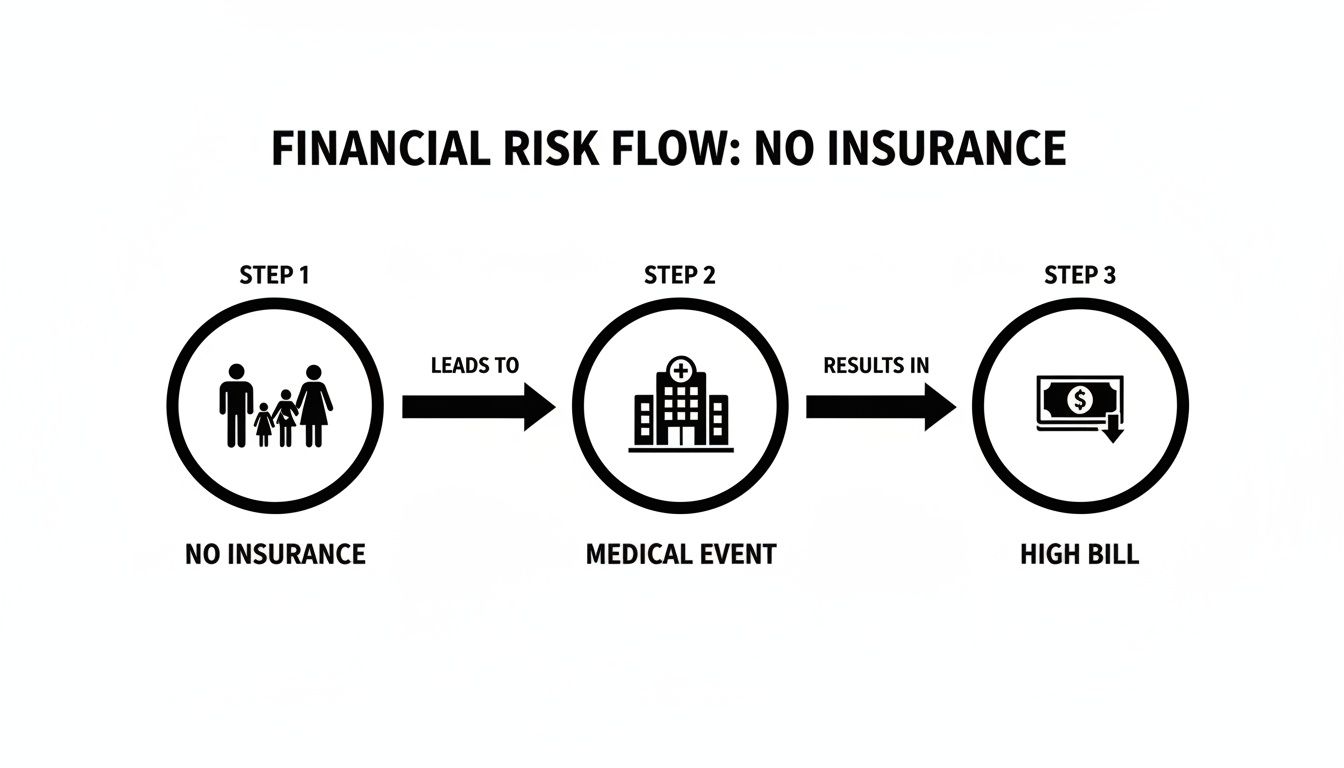
This flowchart illustrates the stark reality: an absence of insurance creates a direct path from an accident or illness to a crushing medical bill. Once this risk is fully appreciated, securing the right policy becomes a mission with a clear objective.
1 Assess Health and Trip Specifics
Your first task is to gather the relevant facts. A vague understanding of your parents' health is insufficient—details are required.
- Document all pre-existing conditions. Compile a list of every chronic illness, past surgery, and current medication. This is crucial for understanding how a policy’s “acute onset” clause might apply.
- Confirm the exact duration of the stay. The policy must provide coverage from the moment they depart their home country until the day they return. There can be no gaps.
- Outline their planned itinerary. Will they be based in a major metropolitan area with extensive medical facilities, or will they travel to more remote locations? This detail helps determine the importance of a broad provider network and robust medical evacuation benefits.
2 Compare Policies Beyond the Premium
With these facts, you can begin comparing plans. The most significant error is choosing based on price alone. True value lies in the quality of the coverage and the insurer's reliability.
A key differentiator is the insurer’s provider network. A large, established PPO network offers your parents a wide selection of physicians and hospitals that will bill the insurance company directly. This minimizes out-of-pocket cash flow during a stressful time.
You must also vet the insurer's reputation. Investigate their claims process and review customer service feedback. A low premium is of no value if the company is unresponsive when a claim is filed.
The sophistication of the insurance market is growing to meet traveler demands. This expansion ensures that discerning individuals have access to high-quality products designed specifically for the unique medical and financial risks of international family travel.
The data support this. In 2024, American travelers spent $5.56 billion on travel insurance, a 46% increase from 2019. With the U.S. expecting 77.7 million international visitors in 2024, the availability of specialized health plans for visiting family has improved significantly. You can find more details on the expanding travel insurance market on emergencyassistanceplus.com.
3 Prepare Documentation and Purchase
Once you have identified the appropriate policy, the final step is purchasing it. This is typically a straightforward online process.
Be prepared to provide the following information for each parent:
- Full Legal Name: Exactly as it appears on their passport.
- Date of Birth: Used for accurate premium calculation.
- Passport Number: For identification and verification.
- Travel Dates: The specific start and end dates for the coverage period.
Finally, proof of comprehensive health insurance can be a powerful supporting document for a B-2 visitor visa application. It demonstrates to consular officers that your parents are prepared for emergencies and are not likely to become a public charge, which can strengthen their application.
Your Questions Answered
When arranging health insurance for your parents' visit to the USA, many specific questions arise. Let us address the most common ones directly to provide the clarity you require.
When Is the Best Time to Buy Visitor Health Insurance?
The optimal time to purchase the policy is before your parents begin their journey to the USA. Ensure the policy is active on the day they depart their home country.
This guarantees coverage during their flight and from the moment they arrive. Purchasing in advance also affords you the time to thoroughly review the policy documents and understand the terms of coverage without the pressure of a last-minute deadline.
Can I Extend the Insurance Policy If My Parents Stay Is Prolonged?
Yes, most high-quality visitor insurance plans are extendable. The critical condition is that the extension request must be made before the current policy expires, and your parents must continue to meet the plan's eligibility criteria.
It is imperative to review the specific terms regarding extensions when you first purchase the policy. Some plans impose a maximum total duration, so if there is any possibility of an extended stay, this should be factored into your initial selection.
Understanding the claims process is just as vital as the policy benefits. In an emergency, knowing who to call and what to present can significantly reduce stress and ensure prompt coordination between the insurer and the medical facility.
What Happens in a Medical Emergency?
First, proceed to the nearest hospital or urgent care facility immediately. In a genuine emergency, medical attention is the paramount priority. Once the situation is stable, you must call the 24/7 emergency assistance line provided by your insurer.
Present the insurance ID card to the hospital's administrative staff. This is a crucial step. The insurance company will then coordinate directly with the hospital for billing on covered expenses. This process, often called 'direct pay,' is designed to prevent you from having to pay large hospital bills out of pocket.
Does Visitor Insurance Cover Pre-Existing Medical Conditions?
This is a critical question with a nuanced answer. Standard visitor insurance policies are not designed to cover routine care or planned treatments for conditions your parents already have.
However, many plans offer coverage for an 'acute onset of a pre-existing condition.' This is a specific term for an unforeseen emergency or a sudden flare-up of a condition that was previously stable. You must read the policy's precise definition of this term, as the scope of coverage can vary dramatically between insurers.
Securing the right international medical insurance requires objective, expert guidance. As specialists serving a discerning global clientele, Riviera Expat provides the clarity and support needed to protect your visiting parents with confidence. Schedule your complimentary consultation with Riviera Expat today.