
Of all the numbers and codes on your health insurance card, one is paramount: the subscriber number. Consider it the master key to your entire health plan. It is the unique identifier that links the primary policyholder—the subscriber—and any family members on the plan to your specific benefits and coverage.
The Most Important Number on Your Health Insurance Card
Much like a primary account number at a private bank, the subscriber number serves as the central identifier for your insurance policy. It is the one code that connects every single interaction back to your specific plan, whether it's a consultation with a specialist, a hospital stay, or a simple prescription refill.
For high-net-worth individuals and expatriates managing sophisticated international or family policies, understanding this number is non-negotiable. It ensures seamless access to premier healthcare globally, helping you circumvent administrative complexities and unexpected expenses that can arise from incorrect information.
The Role of the Subscriber Number
At its core, the subscriber number's function is straightforward but absolutely essential. It is the primary piece of information healthcare providers and pharmacies require to:
- Verify Your Coverage: It allows them to instantly confirm that your policy is active and ascertain the extent of your coverage.
- Process Claims Accurately: It guarantees that billing is directed to the correct insurance company and credited to your account.
- Access Your Benefits: It enables them to retrieve your specific plan details, such as copayments, deductibles, and coverage limits.
Your subscriber ID is the single most important piece of information you provide to a healthcare professional. It establishes the direct link between the medical care you receive and the financial protection your plan offers, making it the linchpin of the entire process.
Ultimately, this string of numbers dictates the efficiency and smoothness of your healthcare experience. When you present your card, that number initiates the entire verification and billing process. It is the key that unlocks the full value of the premiums you invest in top-tier health coverage. This guide will demystify this critical number, providing the confidence to navigate your healthcare with precision.
How to Locate Your Subscriber Number
Finding your subscriber number on an insurance card is generally simple once you know what to look for. This number is your direct link to your benefits.
Most insurers position this key piece of information prominently on the front of the card. You will want to scan for terms such as 'Subscriber ID,' 'Member ID,' or simply 'ID.' While every insurer's card layout may differ slightly, the purpose of this number is always the same: it is the primary code that connects you to your specific health plan.
Think of it as the central hub for your entire policy. This one number links the main policyholder, any dependents on the plan, and all the benefits to which you are entitled.
This map reinforces the point that everything—from your personal identification to your family’s access to care—stems from this single, critical number.
Common Card Layouts
Let's examine a typical layout. You will notice the subscriber number is clearly labeled and kept separate from other information like group numbers or plan types. This deliberate design is meant to prevent any confusion when you are at a medical facility or pharmacy.
On family plans, all members typically share the same primary subscriber number. The only potential difference you might see is a unique two-digit suffix (e.g., -01 for the policyholder, -02 for a spouse) to differentiate each family member.
Your subscriber number is the definitive link to your policy. Providing it correctly is the first step toward a smooth, hassle-free interaction with any healthcare provider, whether at home or abroad.
It is a small detail that plays a crucial role in a massive global system. The worldwide health insurance market was valued at USD 2.8 trillion in 2023 and is projected to reach USD 5.9 trillion by 2033. To put that in perspective, a single major insurer like Cigna reported having 189.7 million customer relationships at the end of 2022—each one identified and managed by a unique subscriber number. You can explore more data on the health insurance market growth to appreciate the scale of this industry.
Subscriber ID vs. Group Number
One of the first things you will notice on an insurance card is a collection of different numbers. It is easy to confuse them, but knowing the distinction between your subscriber ID and your group number is key to ensuring smooth, efficient billing. They may look similar, but they perform entirely different functions.
The number you will use most often is the subscriber number on insurance card, which might also be called a "Member ID" or "Policy ID." Think of this as your unique fingerprint within the insurance system. It links directly to you, the primary policyholder, and anyone else covered under your specific plan.
The group number, on the other hand, identifies the organization that sponsors your health plan. This is typically your employer, but it could also be a professional association or another large entity that provides insurance to its members.
An Analogy to Make It Clear
Imagine your health insurance plan as a large, exclusive apartment building.
- The Group Number is the street address of the entire building. It informs the provider's office which company or organization the plan belongs to.
- Your Subscriber Number is the unique key to your specific residence within that building. It unlocks access to your personal benefits, claims history, and coverage details.
Presenting the correct number at a clinic is what differentiates a claim that is processed seamlessly from one that is rejected. While both are necessary for billing, it is the subscriber number that confirms your individual coverage.
To help you manage all the numbers you might see, here is a breakdown of the most common identifiers and their functions.
Key Identifiers on Your Health Insurance Card
| Identifier | Primary Function | Who It Identifies |
|---|---|---|
| Subscriber Number | Your unique personal ID for benefits and claims. | You, the primary policyholder, and any dependents. |
| Group Number | Identifies the employer or organization's plan. | The entire company or group enrolled in the plan. |
| Policy Number | Often used interchangeably with Subscriber Number. | The specific insurance contract. |
Essentially, your subscriber number proves you are a covered individual, while the group number validates the plan itself. You need both for accurate processing, but they are not interchangeable. Confusing them is a certain way to create administrative difficulties and delays.
The subscriber number validates you as the insured individual, while the group number validates the plan itself. Both are required for accurate claim processing, but they are not interchangeable. Confusing them can lead to significant administrative delays.
This distinction becomes even more important when you are managing multiple, more complex insurance products as an expatriate. Clarifying these details from the outset empowers you to communicate effectively with providers and prevent frustrating—and potentially costly—errors. To become more familiar with these and other key terms, it is worthwhile to learn more about how to interpret your expat medical insurance policy terms. A small investment in knowledge here contributes significantly to a seamless healthcare experience, regardless of your location.
Why Your Subscriber Number Is Essential for Care
Think of your subscriber number as the master key to your entire health plan. It is the one piece of information that unlocks everything, connecting you, your physician, and your insurer in a seamless loop. Without it, you are essentially invisible to the system.
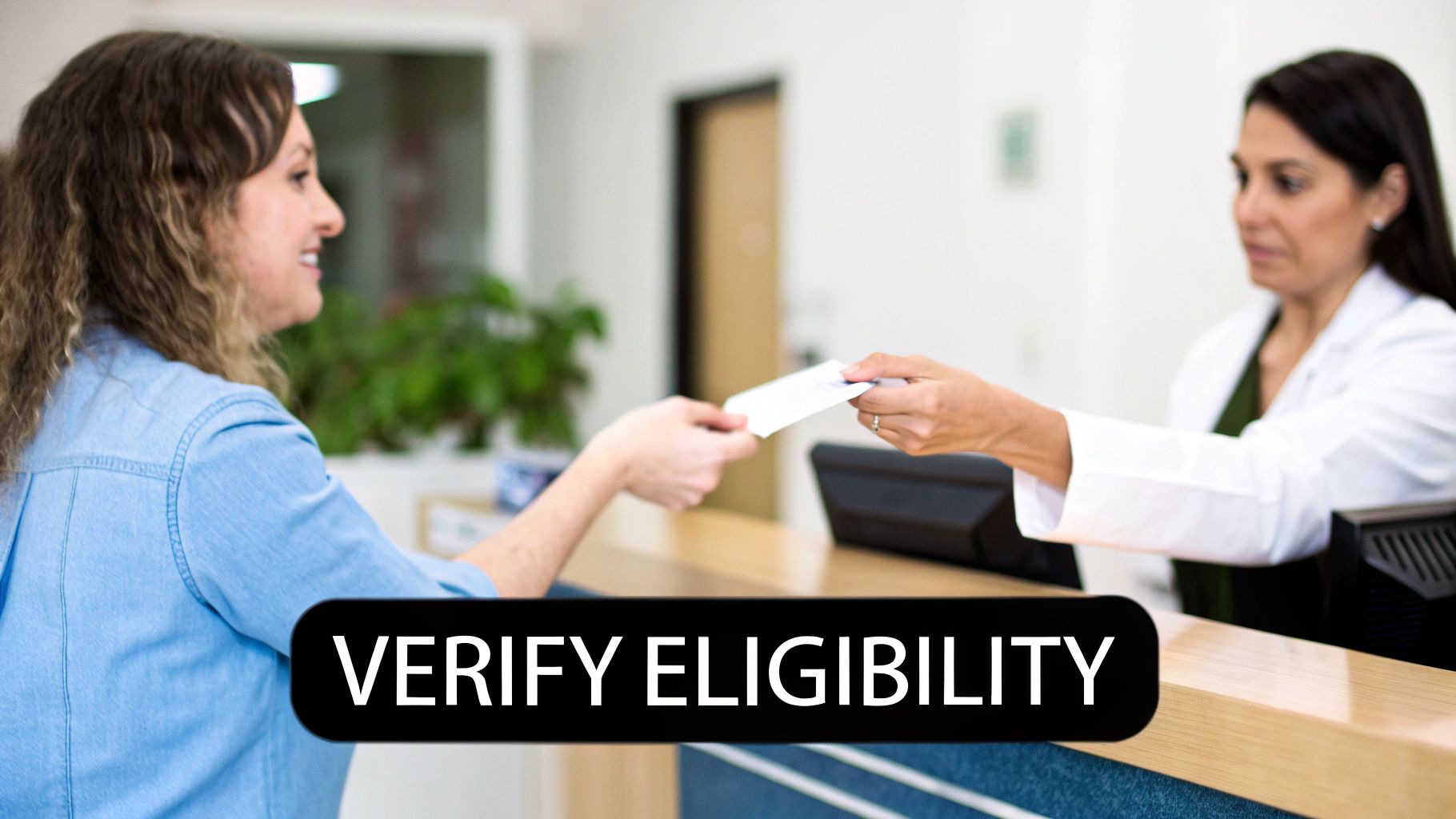
Whether you are scheduling a specialist visit, collecting a prescription, or filing a claim for reimbursement, this number is non-negotiable. For expatriates and global citizens, its importance is even greater—it is the universal code that links you to your insurer's worldwide network of providers, ensuring you receive the care you are entitled to, no matter where you are.
Your Direct Link to Billing and Benefits
The moment you present your insurance card, that subscriber number on insurance card initiates a critical chain of events. It allows the clinic's administrative staff to instantly access your file and verify several key points:
- Eligibility Status: Are you an active, paid-up member?
- Coverage Specifics: What exact treatments, procedures, and medications does your plan cover?
- Financial Details: What are your deductibles, co-payments, and other cost-sharing responsibilities?
Understanding how your subscriber number functions is the first step to utilizing your health plan without difficulty. It prevents administrative roadblocks when your focus should be on your health.
This number is also vital for significant medical events. It is a requirement when seeking approval for major treatments, a process you can learn more about in our guide to pre-authorisation and direct settlement procedures.
This simple identifier is the bedrock of a massive global industry. According to the OECD, total health spending across its member countries was USD 10.3 trillion in 2022. The entire framework, which manages care for millions of people, hinges on these unique numbers to process every single transaction accurately.
Navigating International and Expatriate Health Plans
For individuals whose lives and work cross borders, a robust International Private Medical Insurance (IPMI) plan is not a luxury—it is essential. Consider the subscriber number on your IPMI card as your universal key, unlocking a network of high-quality healthcare facilities around the world. It is the one number that cuts through local bureaucracy, ensuring your benefits are recognized instantly, wherever you are.
However, a common pitfall for new expatriates is that the terminology for this crucial number can vary by location. A 'Policy ID' in Singapore could be referred to as a 'Subscriber Number' in London. This is not a minor detail; it can cause significant complications. The best approach is proactive. Before seeking care in a new country, confirm with your insurer which number the local clinic will require. Getting this right guarantees smooth direct billing and saves you from a mountain of paperwork later.
Preparing for Global Healthcare Access
To ensure you can access care without issue, a small amount of preparation is highly effective. Keeping your health information accessible and secure while abroad is a prudent measure.
- Secure a Digital Copy: Capture a clear, high-resolution image of your insurance card and save it in an encrypted file on your phone and laptop. If your physical card is lost, you will still have immediate access to your subscriber number and all other vital details.
- Program Key Contacts: Do not wait for an emergency. Save your insurer’s 24/7 international assistance or concierge hotline directly into your phone’s contacts. This simple action provides a direct line to expert help when you need it most.
When operating across borders, your subscriber number is much more than an ID. It is your passport to consistent, high-quality medical care. Verifying how it is used in each new location is the mark of a well-prepared expatriate.
As an expatriate, you may encounter official healthcare documents in a foreign language. In this situation, engaging professional official document translation services is a wise investment to ensure you comprehend everything perfectly. A full understanding of your plan is critical, and you can learn more about the specific benefits of international private medical insurance in our detailed guide.
Protecting Your Health Information and Subscriber Number
Consider your subscriber number as more than just a string of digits. It is the key that unlocks your most sensitive personal health information. You would not share your bank account details publicly, and this number deserves the same level of discretion.
Treating this number with care is your first line of defense against identity theft and insurance fraud. This involves simple, commonsense habits. Avoid posting images of your insurance card online and be wary of any unsolicited emails or calls requesting your plan details.
When you receive a new card, do not simply discard the old one. Shred it. Ensure that the information is completely unreadable before you dispose of it.
Secure Digital Management
Today, most premier insurers offer secure online portals and mobile applications to manage your policy. These tools are built with multiple layers of security to protect your data, but their effectiveness depends on proper use.
A few simple protocols will keep your account secure:
- Always use the official app or website provided by your insurer, not a third-party link.
- Create a strong, unique password for your insurance account—do not reuse one from your email or social media.
- Enable two-factor authentication (2FA) whenever it is offered. It is one of the most effective ways to add an additional layer of security to your digital access.
Maintaining strict control over your subscriber number is not just a good practice—it is an absolute necessity for protecting your privacy and your financial well-being.
By making these security measures a habit, you can manage your healthcare benefits with the confidence and control you should expect.
Common Questions About Your Subscriber Number
Even with a firm grasp of your policy, a few practical questions often arise. Clarifying these details is key to managing your healthcare confidently, regardless of your location.
One of the most common points of confusion relates to family coverage. Does every family member receive a unique subscriber number? Generally, no. The primary policyholder is assigned one central subscriber number, and all dependents on the plan are organized under it, often with a simple two-digit suffix (e.g., -01, -02) to differentiate them.
What to Do in Common Scenarios
What should you do if your insurance card is lost or stolen? First, remain calm, but act swiftly. Contact your insurer immediately to report the loss. They will deactivate the old card to prevent any unauthorized use and initiate the process of issuing a replacement.
Many top-tier insurers now provide a digital version of your card directly within their secure app, which can be invaluable. This raises another frequent question: are these digital cards universally accepted?
Yes, for the most part. The majority of modern clinics and pharmacies are equipped to process digital insurance cards. Nevertheless, it is a prudent habit to call ahead and confirm, especially if you are traveling or visiting a new provider for the first time. For a deeper dive into how health coverage works in general, you may find this resource on general health insurance information useful.
At Riviera Expat, we provide the clarity and control you need to manage your international health insurance with confidence. Contact us for a complimentary consultation.