
Securing the right Thailand medical insurance is more than a formality on your relocation checklist; it's a foundational component of your financial and personal well-being in the Kingdom. For discerning expatriates, the choice isn't just about healthcare—it's a strategic decision that underpins a global lifestyle and a sophisticated approach to risk management. The question boils down to two distinct paths: a standard local Thai policy or a premium International Private Medical Insurance (IPMI) plan.
Understanding the Thai Healthcare Landscape for Expats
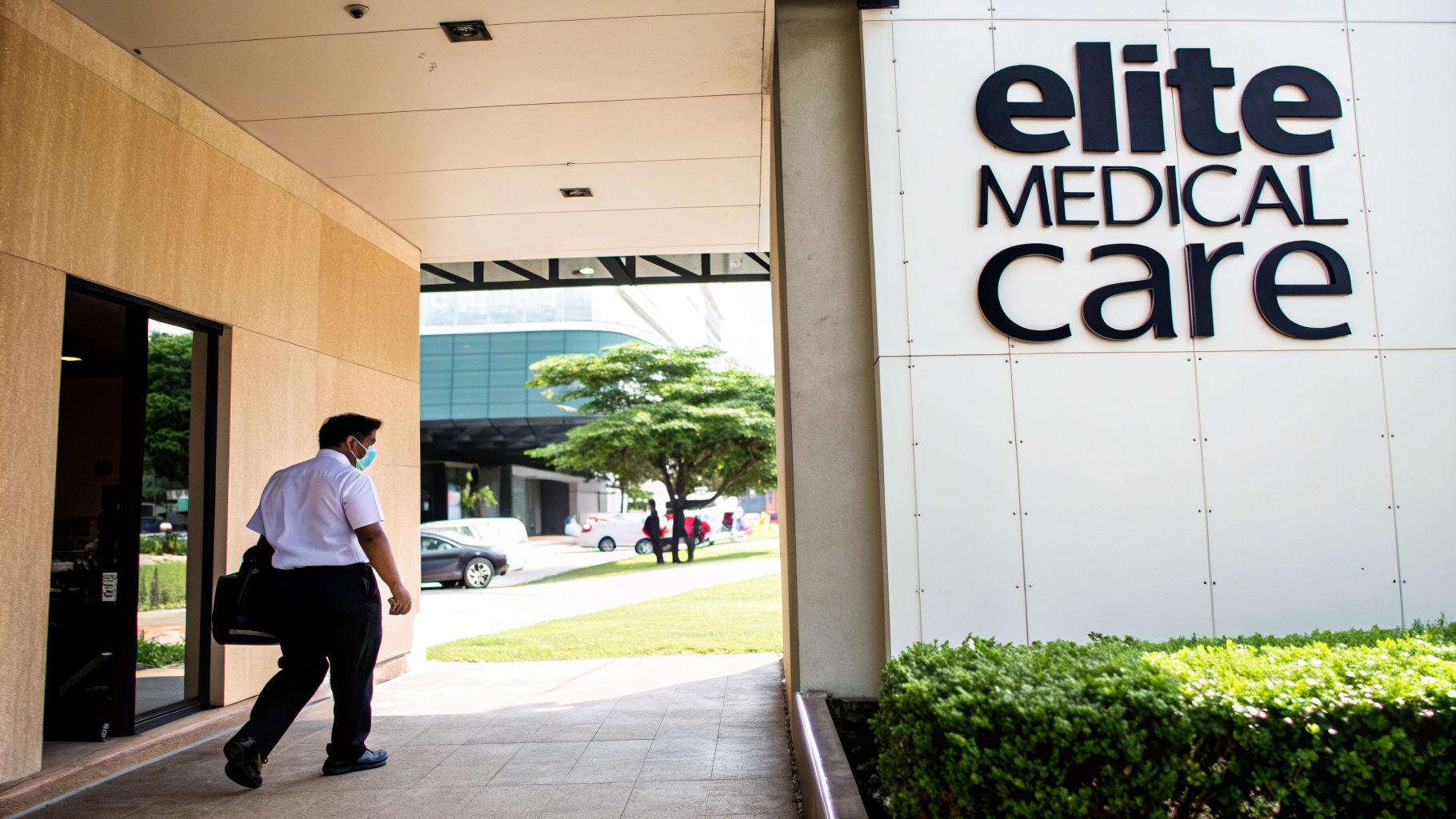
To operate effectively in Thailand, one must first grasp the nuances of its medical infrastructure. The country operates a dual healthcare system. On one hand, you have world-class private hospitals that attract a significant volume of international medical tourism. On the other, there is a public system with its own set of capacity and service-level challenges. This dichotomy necessitates a critical decision for professionals accustomed to global standards of excellence.
Choosing between a standard local policy and a robust IPMI plan is a foundational strategic choice. The comparison is akin to selecting a generic, off-the-shelf financial product versus structuring a bespoke investment portfolio. One is designed for sophisticated needs and global mobility, while the other serves a more basic, localized purpose.
The Dual System: A Tale of Two Tiers
Thailand’s private healthcare sector is impressive. It is recognized for its JCI-accredited facilities, English-speaking specialists, and a service quality that often resembles five-star hospitality. These institutions, such as the renowned Bumrungrad International Hospital and Samitivej Sukhumvit Hospital, are the preferred choice for expatriates and high-net-worth individuals who demand immediate access to premier care.
The public system, while functional for the general populace, presents a different experience. It is often characterized by long waiting times and a level of service that may not meet the expectations of a global professional. This is precisely why a quality private medical insurance plan is not a luxury—it is an absolute necessity for seamless access to the country's best medical resources.
Why Your Insurance Choice Is a Strategic Asset
You would not leave your financial assets unprotected, so why treat your health any differently? The right insurance plan is more than a safety net; it's an enabler for your life and career in Southeast Asia. A policy that underperforms during a medical crisis can trigger significant financial and personal consequences.
This guide is structured for professionals who require a healthcare solution that delivers:
- Clarity: A precise understanding of your coverage, limits, and direct billing networks.
- Control: The freedom to choose the best doctors and hospitals without being constrained by financial considerations.
- Confidence: The absolute assurance that your health is protected to the highest international standards.
Choosing your Thailand medical insurance is a critical element of your global financial and lifestyle strategy. It ensures your health is protected with the same diligence you apply to your wealth, providing peace of mind whether you are in Bangkok or traveling for business.
Ultimately, navigating the options requires a strategic mindset. You need to assess not just your immediate needs but also your future plans, potential international travel, and the level of service you will not compromise on. By framing the decision this way, you ensure your health coverage becomes a powerful asset that actively supports your life abroad.
Local Thai Policies Versus International IPMI Plans
When it comes to securing medical coverage in Thailand, you are presented with two fundamentally different options: a local Thai insurance policy or a comprehensive International Private Medical Insurance (IPMI) plan. This is not merely about selecting a plan; it's a strategic decision about the caliber of protection you demand for yourself and your family.
The choice can be compared to that between a standard city vehicle and a high-performance grand tourer. Both provide transportation, but their capabilities, comfort, and reliability under pressure are worlds apart. One is built for local utility, the other for cross-continental journeys with complete assurance.
A local Thai policy often appears attractive due to its lower premium. It can seem adequate for minor, routine medical issues and provides straightforward access to a network of local hospitals. But for a high-net-worth expatriate, the inherent limitations of these plans can create significant financial and personal risks.
The Constraints of Local Insurance
The defining characteristic of local Thai insurance is its restrictions. These plans are known for low annual benefit limits, which can be exhausted by a single serious medical event, such as complex surgery or a lengthy hospital stay.
Furthermore, they often contain restrictive internal sub-limits for specific treatments. You might believe you are covered, only to discover the policy pays just a fraction of the bill for specialized cancer care or orthopedic surgery at a top-tier hospital.
The most significant limitation for many is that pre-existing and chronic conditions are almost universally excluded. This creates a critical, non-negotiable coverage gap for anyone with an ongoing health concern. Finally, their geographic scope is minimal. The moment you travel for business or leisure outside of Thailand, your coverage typically ceases, leaving you exposed.
For a global professional, a local policy’s primary drawback is its inability to match a lifestyle that transcends borders. Its value diminishes the moment you step on a plane or require care for a complex condition that exceeds its modest financial caps.
The Superior Framework of IPMI
International Private Medical Insurance operates on an entirely different scale. IPMI plans are specifically engineered for globally mobile individuals who require seamless, high-quality healthcare anywhere in the world. Their core value proposition is providing exceptionally high—often unlimited—annual benefit limits. This ensures that even the most expensive and prolonged treatments are fully covered, removing financial anxiety from the equation during a medical crisis.
You can learn more by reading our in-depth guide to international private medical insurance.
These plans are structured to cover complex medical needs: advanced cancer treatments, chronic condition management, and even organ transplants. Portability is the other pillar of IPMI; your policy travels with you, whether you’re on a business trip to Singapore or visiting family back home in Europe. For professionals whose lives are not confined to one country, this global continuity of care is essential.
In addition, IPMI providers grant direct billing access at a worldwide network of elite hospitals. This eliminates the need to handle large upfront payments for inpatient care at institutions like Bumrungrad International or Samitivej Sukhumvit. It’s a frictionless, high-level patient experience that local plans cannot offer.
This distinction is more vital than ever. The Thailand health insurance market was valued at $35.72 USD Billion in 2024 and is projected to reach $46.93 USD Billion by 2032. This growth is fueled in part by medical inflation rates that can approach 15% annually in some private facilities, making robust, high-limit coverage an indispensable asset. You can find more insights on the Thai market's growth at Data Bridge Market Research.
Local Thai Insurance Vs International IPMI: A Strategic Comparison
To crystallize the differences, a side-by-side comparison is useful. This table breaks down the fundamental trade-offs between a standard local Thai policy and a comprehensive IPMI plan, helping you determine which truly aligns with the demands of an expatriate lifestyle.
| Feature | Local Thai Insurance Policy | International Private Medical Insurance (IPMI) |
|---|---|---|
| Annual Benefit Limit | Typically low (e.g., $30,000 – $100,000 USD), easily exhausted by serious medical events. | Very high or unlimited (e.g., $2,000,000+ USD), providing comprehensive financial protection. |
| Geographic Coverage | Primarily limited to Thailand, with little or no international coverage. | Global or worldwide (often with an option to exclude the USA), ensuring portability for travel and relocation. |
| Pre-Existing Conditions | Almost always excluded, creating significant coverage gaps for those with prior health issues. | Often coverable through specialized underwriting, moratoriums, or premium loading. |
| Complex & Chronic Care | Severely restricted with low sub-limits for cancer, cardiac, and long-term illnesses. | Designed to fully cover high-cost, long-term treatments with extensive benefits. |
| Hospital Network Access | Access to a network of local Thai hospitals, with variable direct billing arrangements. | Access to a global network of elite hospitals with seamless direct billing (cashless) services. |
| Best For | Short-term visitors or residents with no pre-existing conditions and minimal travel plans. | High-net-worth expatriates, frequent travelers, and families demanding the highest standard of global healthcare. |
Ultimately, the choice comes down to your personal risk tolerance and lifestyle. A local plan might cover basic needs, but an IPMI plan is an investment in comprehensive security, ensuring you have access to world-class care no matter where life takes you.
Evaluating Critical Coverage Components in Thailand

In developing a serious risk management strategy, the details are paramount. For high-net-worth individuals residing in Thailand, a standard, off-the-shelf Thailand medical insurance plan is insufficient, as it overlooks the non-negotiable coverage areas that provide genuine peace of mind.
A premium IPMI policy is defined not by its price, but by the depth of its coverage in these mission-critical areas. These should be viewed not as optional add-ons, but as foundational pillars supporting a global lifestyle.
Let's break down four of these critical components: medical evacuation, chronic condition management, elite maternity care, and executive mental health support. Understanding these is key to selecting a plan that performs flawlessly when it matters most.
Medical Evacuation and Repatriation
While Thailand boasts world-class private hospitals, certain highly specialized procedures or personal preferences may necessitate treatment elsewhere in Asia or in your home country. This is where medical evacuation and repatriation coverage becomes indispensable. It is the logistical and financial engine that ensures you can access the best possible care, regardless of its location.
Consider a senior executive experiencing a complex cardiac event while on holiday in a remote part of Thailand. The leading specialist for their specific condition may be in Singapore. A standard policy might cover local treatment, but a robust IPMI plan coordinates and pays for everything—from the air ambulance to admission at the destination hospital. It is about ensuring access to the absolute best care, without compromise.
This coverage is your lifeline and typically includes:
- Emergency medical evacuation: Transportation to the nearest top-tier medical facility capable of managing your specific emergency.
- Medical repatriation: Transport back to your home country for follow-up treatment or recovery once you are medically stable.
- Compassionate visit: Covers the travel costs for a family member to be by your side if you are hospitalized abroad for an extended period.
Managing Chronic and Pre-Existing Conditions
For professionals managing a long-term health issue, continuity of care is paramount. This is perhaps the single greatest differentiator between local Thai policies and a premium IPMI plan. Local plans almost universally exclude pre-existing conditions, leaving an unacceptable gap in protection.
IPMI policies, conversely, are designed to handle the high-cost, long-term reality of managing chronic illness. Through detailed underwriting, insurers can offer proper coverage for conditions such as diabetes, hypertension, or autoimmune disorders. This means you have uninterrupted access to specialists, vital prescription medications, and treatments without the concern of exhausting a low annual limit.
You can learn more about how insurers handle medical conditions and cover in our detailed guide.
For a business leader with a managed chronic condition, an IPMI policy isn't just insurance; it's a strategic tool that guarantees their health management regimen continues seamlessly, whether they are in Bangkok, London, or Hong Kong.
Elite Maternity and Newborn Care
Bangkok is home to some of the world's finest private maternity hospitals, where the service level is exceptional. For expatriate families planning to have a child in Thailand, comprehensive maternity and newborn care coverage is the only way to take full advantage of these facilities without facing bills that can reach six figures.
Premium IPMI plans are designed to meet these high standards. They provide extensive coverage for:
- All routine prenatal consultations and screenings.
- Delivery costs, including obstetrician and hospital fees for both natural and Caesarean section births.
- Potential complications that could arise for both mother and child.
- Immediate, seamless coverage for the newborn, including neonatal intensive care if required.
Executive Mental Health and Wellness Benefits
The intense pressures on senior professionals have brought executive mental health into focus. Leading IPMI providers now recognize this as a critical component of overall well-being, and their benefits reflect this understanding. This goes beyond basic coverage, offering confidential and extensive access to top-tier therapy, counseling, and preventive wellness programs.
This growing priority is reflected in market trends. According to the Thai Life Assurance Association (TLAA), health insurance riders have become a significant part of the sector. For executives, this heightened health awareness includes a greater focus on mental resilience and wellness. These advanced benefits ensure that you and your family have the resources to thrive, not just survive, in a high-stakes professional environment.
Underwriting, Premiums, and Thai Visa Rules: The Technical Details

Securing the right Thailand medical insurance involves more than selecting a high coverage limit. It requires an understanding of the mechanics behind the policy. For high-net-worth expats, the objective is not simply to find the cheapest plan, but to secure true value and ensure the policy meets all requirements—both for personal health and for Thai immigration authorities.
Two processes define this landscape. First is underwriting, the insurer's detailed risk assessment that determines your final terms and price. Second is ensuring your plan satisfies Thailand's specific visa regulations.
The underwriting for a premium IPMI policy can be compared to the due diligence process for a major investment. The insurer must meticulously assess the risk to price your policy accurately. This is not about finding ways to increase your cost; it's about building a sustainable plan that will perform reliably under the pressure of a major claim.
The Art and Science of Underwriting
When you apply for a premium IPMI plan, the underwriting process is a detailed evaluation. Insurers analyze several key factors to construct your policy and calculate the premium.
Here’s what they are assessing:
- Age and Medical History: These are primary factors. Insurers require a clear picture of your past and present health, especially any pre-existing conditions, to project potential future medical needs.
- Lifestyle Choices: Activities such as smoking or engaging in high-risk hobbies will affect your premium, as they are directly correlated with health risks.
- Geographic Coverage: The logic is straightforward. A "Worldwide" policy will have a higher premium than one that excludes expensive healthcare systems like that of the USA.
This is not a one-size-fits-all formula. It is a bespoke process designed to match your premium to your personal risk profile, ensuring the comprehensive coverage is priced fairly.
A properly underwritten policy is the bedrock of a reliable insurance plan. It eliminates ambiguity and guarantees that when a claim is made, the coverage performs exactly as expected, providing complete financial security during a medical event.
Structuring Premiums for Optimal Value
While the bottom-line cost of an IPMI plan is a consideration, the goal is to structure it for maximum value. This can involve the strategic use of deductibles and co-payments to reduce premiums without sacrificing essential protection.
A deductible (or excess) is the amount you agree to pay out-of-pocket before the insurance begins to pay. Opting for a higher deductible can significantly reduce your annual premium. This is a common strategy for individuals who can comfortably cover smaller medical bills but want ironclad protection against a catastrophic, high-cost event. In essence, you self-insure for minor expenses to secure superior coverage for major ones.
A co-payment functions similarly, requiring you to pay a set percentage of each claim. This cost-sharing model also helps lower your base premium. By carefully balancing these two elements, you can design a policy that aligns with your financial strategy and risk tolerance.
Meeting Thai Visa Health Insurance Mandates
For most expatriates, obtaining the correct long-term visa is a primary concern, and health insurance is a non-negotiable component of that process. Thailand has specific insurance requirements for certain visas, particularly the Non-Immigrant O-A (Long Stay) visa for retirees aged 50 and over.
Currently, applicants for this visa must have health insurance that provides a minimum of THB 3,000,000 (approximately $82,000 USD as of late 2024) for inpatient medical care.
A quality IPMI plan will not just meet this requirement; it will far exceed it, with coverage limits often reaching several million dollars. This not only facilitates your visa application but provides a level of protection far beyond the government’s minimum standard. Securing long-term residency is a foundational piece of the expatriate puzzle, and health requirements are often central. You can learn more about general residency and visa requirements for expats to see how this fits into the bigger picture.
The Claims Process and Accessing Top Hospital Networks
The true value of a medical insurance plan is only revealed at the moment of need. The real test occurs during a medical event, where a superior plan must do more than simply cover the cost—it must make the entire experience seamless and stress-free.
This is where the distinction between a standard local policy and a premium IPMI plan becomes most apparent.
It often comes down to one critical function: how the hospital is paid. Many local Thai policies operate on a reimbursement model. This means you pay the hospital bill yourself, often upfront and in full. You then navigate a paper-intensive process to claim your money back, which can take weeks or months. For any serious procedure, this could result in a significant out-of-pocket expenditure. This is a non-starter for most professionals.
The Superiority of Direct Billing Networks
Premium IPMI providers, in contrast, operate on the undisputed gold standard: direct billing. Often referred to as ‘cashless’ service, it is the bedrock of a genuinely premium patient experience.
With direct billing, you can walk into a top-tier hospital like Bumrungrad International or Samitivej Sukhumvit, present your insurance card, and the financial arrangements are handled directly between the hospital and your insurer. This feature is a game-changer, allowing you to focus on your health, not your finances. IPMI providers achieve this by building powerful, long-standing relationships with the best hospital networks. You can dive deeper into why these networks are so vital in our guide to medical networks for expatriates.
The value of an IPMI plan is crystallized in the moment of need. It’s the confidence of knowing that admission to a top-tier hospital involves a conversation about your health, not your credit limit.
The Crucial Role of Third-Party Administrators
The entity that facilitates this seamless process is the Third-Party Administrator (TPA). A TPA is the operational engine connecting you, the hospital, and the insurance company. They manage claims, verify benefits, and handle the administrative tasks required to make direct billing work. Their efficiency is critical.
The growing importance of this role is reflected in market data. The insurance TPA market in Thailand was valued at $1.54 Billion USD in 2023 and is projected to reach $2.61 Billion USD by 2030. This expansion is driven by increasing health insurance adoption and rising medical costs, which makes a smooth administrative partner more critical than ever. For professionals who expect top-tier service, IPMI plans partner with the best TPAs to deliver a claims experience that avoids the bureaucratic hurdles often found elsewhere. You can read more about the Thai TPA market's rapid growth on nextmsc.com.
A policy is only as good as its performance when you are at your most vulnerable. A robust direct billing network is the ultimate proof of an insurer’s commitment to its clients.
Your Decision Checklist: Finding the Perfect Plan
Selecting the right IPMI plan is not about finding a policy; it is about designing a healthcare solution that aligns with your life in Thailand—and everywhere else your business or leisure takes you. This is where we translate knowledge into action.
Before consulting with an advisor, it is beneficial to conduct a self-assessment. This process helps you enter the conversation with a clear understanding of your needs, streamlining the process and ensuring the optimal outcome.
Use these questions to outline your personal requirements. Your answers will form the foundation for the ideal Thailand medical insurance plan, providing total confidence in your coverage.
Lifestyle and Geographic Footprint
First, let's map out your lifestyle. Your insurance must be as mobile as you are.
- Your Thailand Timeline: How long do you genuinely plan to reside in Thailand? Is this a two-year assignment, the beginning of your retirement, or a permanent relocation? Your answer determines the importance of features like lifetime renewability.
- Travel Habits: How often will you be outside of Thailand for business or personal travel? Be specific. A plan covering "Worldwide excluding USA" is fundamentally different from a truly global one.
- What's Next? Is there a possibility you will relocate to another major hub like Singapore or Dubai—or return to your home country—in the next five years? If so, genuine global portability is non-negotiable.
Personal and Family Health Profile
Next, conduct an honest assessment of your health needs. This is the core of your insurance profile.
- Current Health: Do you or your family have any pre-existing or chronic conditions that require ongoing care? This is the single most important question, as it will shape the underwriting process.
- Family Plans: Are you considering starting or expanding your family in the near future? If so, top-tier maternity and newborn care with high benefit limits must be a core component of your plan.
- Wellness Goals: Do you place a high value on preventive health, such as annual executive check-ups, mental health support, or even alternative therapies? The best plans include generous allowances for these, but you must know to look for them.
Think of these questions as the essential data points an expert advisor needs to filter the market for you. By getting clear on these issues first, you shift from a generic, overwhelming search to a highly targeted selection process. This checklist is the tool that ensures the plan you choose is a perfect fit, not just a close-enough guess.
Frequently Asked Questions
When it comes to Thailand medical insurance, numerous questions arise, especially for professionals managing a global lifestyle. Here are straightforward answers to the inquiries we hear most often from our clients.
Can I Use My Existing International Insurance Plan in Thailand?
Yes, provided you have a high-quality International Private Medical Insurance (IPMI) policy. These plans are specifically designed for global portability.
The first step is to verify your policy's 'area of coverage.' Most premium plans offer 'worldwide' or 'worldwide excluding USA' options, both of which would cover you in Thailand. It is critical to notify your insurer of your move to Thailand to ensure your coverage remains active and valid. This is also the ideal time to confirm that your plan’s benefits are aligned with the costs at Thailand's top private hospitals and that it satisfies all local visa requirements.
Are Bangkok's Top Private Hospitals Included in IPMI Networks?
Absolutely. The best IPMI providers build their networks around the world-class, JCI-accredited hospitals that are favored by expatriates and medical tourists.
You will find that internationally renowned facilities such as Bumrungrad International Hospital, Samitivej Sukhumvit Hospital, and the entire Bangkok Hospital network are standard partners. This direct relationship enables access to direct billing (cashless) services for inpatient stays and, often, for outpatient care as well. It provides a seamless experience comparable to using top-tier insurance in your home country.
How Do Insurers Handle Pre-Existing Conditions in Thailand?
This is where the distinction between local and international plans is most pronounced. Local Thai insurance policies will almost always exclude pre-existing conditions entirely, without exception.
Premium IPMI providers, however, employ a more sophisticated approach.
Depending on your specific condition, they may offer coverage in several ways:
- A moratorium period: They may agree to cover the condition after a specified period (typically 24 months) has passed with no symptoms, treatment, or advice sought.
- A premium surcharge: They might apply a loading to your premium to account for the additional risk.
- Full coverage from day one: For well-managed and stable conditions, some insurers will offer full coverage from the outset.
For anyone with a known health condition, IPMI isn't just a better option—it's often the only viable path to securing real, comprehensive coverage. It closes the dangerous protection gaps that local policies leave wide open.
What Is the Cost Difference Between Local and IPMI Policies?
The difference is analogous to that between a basic toolkit and a professional mechanic's workshop. A local Thai plan may cost only a few hundred US dollars per year, but it comes with minimal benefit limits and an extensive list of exclusions.
A comprehensive IPMI policy represents a more significant investment. For a healthy individual in their 30s or 40s, premiums can range from $3,000 to $8,000 USD annually. This investment secures multi-million dollar coverage limits, the freedom to use it globally, and robust protection against a major medical crisis. For professionals who cannot afford any weak links in their financial strategy, it is an essential investment.
Secure the clarity, control, and confidence you deserve in your healthcare. For expert, objective guidance on securing the right international medical insurance for your life in Thailand, contact Riviera Expat for a complimentary consultation at https://riviera-expat.com.