
Consider a comprehensive health check-up as a meticulous audit for your most valuable asset: your body. It is a systematic review of your current physiological status, engineered to identify potential risks and underlying conditions long before they manifest as significant health issues. For the high-achieving global professional, it's an indispensable tool for sustaining peak performance and ensuring longevity.
Your Strategic Advantage in Peak Performance
For high-net-worth individuals and discerning professionals, proactive health management is not a luxury—it is a core component of a personal risk management strategy. An executive health check-up transcends standard medical advice. It reframes preventive care as a strategic investment in your capacity to operate at the highest level, consistently.
Just as you meticulously manage a financial portfolio, actively managing your health provides critical data, identifies risks early, and protects your future earning potential.
This guide is not about conventional wellness tips. It is structured to articulate how a premium health screening directly impacts your International Private Medical Insurance (IPMI) portfolio and how to navigate this landscape with precision. Understanding this synergy is essential for building a robust foundation for both long-term well-being and formidable financial protection.
The Modern Health Assessment
The concept of a "routine check-up" has evolved significantly. It is no longer a reactive visit prompted by symptoms; it is a forward-looking analysis of your body’s intricate systems. This shift is powered by a more sophisticated understanding of how lifestyle, genetics, and environment intersect to shape long-term health outcomes.
The demand for these detailed assessments has grown substantially, establishing preventive care as a major global sector. The worldwide market for preventive health check-ups has expanded into a multi-billion dollar industry, valued at USD 66.84 billion in 2023 and projected to reach USD 120.98 billion by 2030.
A primary driver behind this growth is the global rise in noncommunicable diseases, such as cardiovascular conditions and diabetes, which makes routine screening more critical than ever. You can find more insights on the preventive health market on Grand View Research.
A Framework for Action
When viewed through a strategic lens, a health check-up offers several key advantages that resonate with the mindset of a successful executive:
- Creates Your Baseline Data: It establishes a detailed snapshot of your current health. This becomes the baseline against which all future changes can be accurately measured.
- Identifies Risks Early: Advanced diagnostics can uncover silent risks—such as early-stage cardiac issues or metabolic imbalances—long before symptoms would ever be felt.
- Optimizes Your Performance: The results deliver actionable insights you can use to fine-tune energy levels, sharpen cognitive function, and build resilience to stress.
- Informs Your Insurance Planning: A clear, well-documented health record places you in a much stronger position when securing or renewing a high-value IPMI policy.
A comprehensive health assessment is the foundational audit for your personal well-being. It transforms abstract health goals into a tangible set of metrics that can be tracked, managed, and optimized for sustained success.
This guide will provide the framework you need to understand and master this vital process.
Decoding the Executive Health Screening
What truly distinguishes a standard health screening from an executive-level assessment? While a typical check-up provides a valuable snapshot of your health at a single point in time, an executive screening is a deep-dive diagnostic experience. It is engineered for the realities of a high-performance lifestyle, moving beyond baseline metrics to deliver a forward-looking analysis of your body’s complex systems.
Consider this analogy: a standard check-up is like a basic vehicle inspection—it confirms the essentials are functional. An executive screening is akin to a Formula 1 diagnostic. It scrutinizes every component to predict performance under pressure and identify subtle weaknesses before they lead to a system failure. For an executive, this means preempting health risks tied to chronic stress, demanding schedules, and frequent international travel.
Comparison of Health Check Up Tiers
To articulate this clearly, let's delineate what is typically included at different levels. This table illustrates how the depth of investigation increases as one progresses from a standard check-up to a full executive screening.
| Feature / Test | Standard Health Check Up | Enhanced Screening | Executive Health Screening |
|---|---|---|---|
| Consultation | GP consultation | Extended GP consultation | Senior physician/specialist consultation |
| Blood Work | Basic (CBC, lipids, glucose) | Comprehensive panel + vitamin D, iron | Advanced panel + cancer markers, hormones |
| Cardiac | Blood pressure, basic ECG | Resting ECG, cholesterol breakdown | Stress ECG, Echocardiogram, CAC Score |
| Cancer Screening | Basic physical exam | Basic markers (e.g., PSA for men) | Comprehensive cancer marker panels |
| Metabolic | Blood sugar (glucose) | HbA1c (long-term sugar control) | Insulin resistance, detailed hormonal analysis |
| Imaging | Chest X-ray (sometimes) | Ultrasound (abdomen, pelvis) | Advanced imaging (e.g., MRI, CT as needed) |
| Lifestyle | General advice | Detailed lifestyle & nutrition consult | Cognitive function, stress/sleep analysis |
| Follow-Up | Results summary | Detailed report & action plan | Personalised health roadmap & follow-up |
As you can see, the executive tier is not merely about more tests; it is about a more strategic and predictive approach to your long-term health and performance.
Core Components of a Premium Screening
An executive health screening is defined by its depth and personalization. It incorporates advanced diagnostics that are seldom found in a standard package, painting a much clearer picture of your long-term health trajectory. These are not just tests; they are strategic tools for proactive health management.
Some of the key differentiators typically include:
- Advanced Cardiac Risk Assessment: This extends far beyond a simple blood pressure reading. It involves a Coronary Artery Calcium (CAC) score to visualize plaque buildup, a stress echocardiogram to observe heart function under strain, and advanced lipid panels that measure particle size—a more accurate predictor of cardiovascular risk.
- Comprehensive Cancer Marker Panels: While not definitive diagnostic tools on their own, these blood tests screen for proteins that can be elevated in the presence of certain cancers. When tracked over time, these markers serve as an invaluable early-warning system.
- Detailed Hormonal and Metabolic Analysis: This is a deep dive into key hormones like testosterone and cortisol, plus markers for insulin resistance and inflammation. The results offer significant insights into energy levels, your body's stress response, and metabolic efficiency.
- Cognitive and Neurological Function Evaluation: For leaders whose primary asset is their intellect, establishing a cognitive baseline is crucial. These assessments track memory, processing speed, and executive function, helping to detect subtle changes early.
This layered approach to health management—where you are the central asset—must be supported by both a detailed health check-up and a robust IPMI plan. This simple graphic illustrates how your health data and your insurance protection are two sides of the same coin.
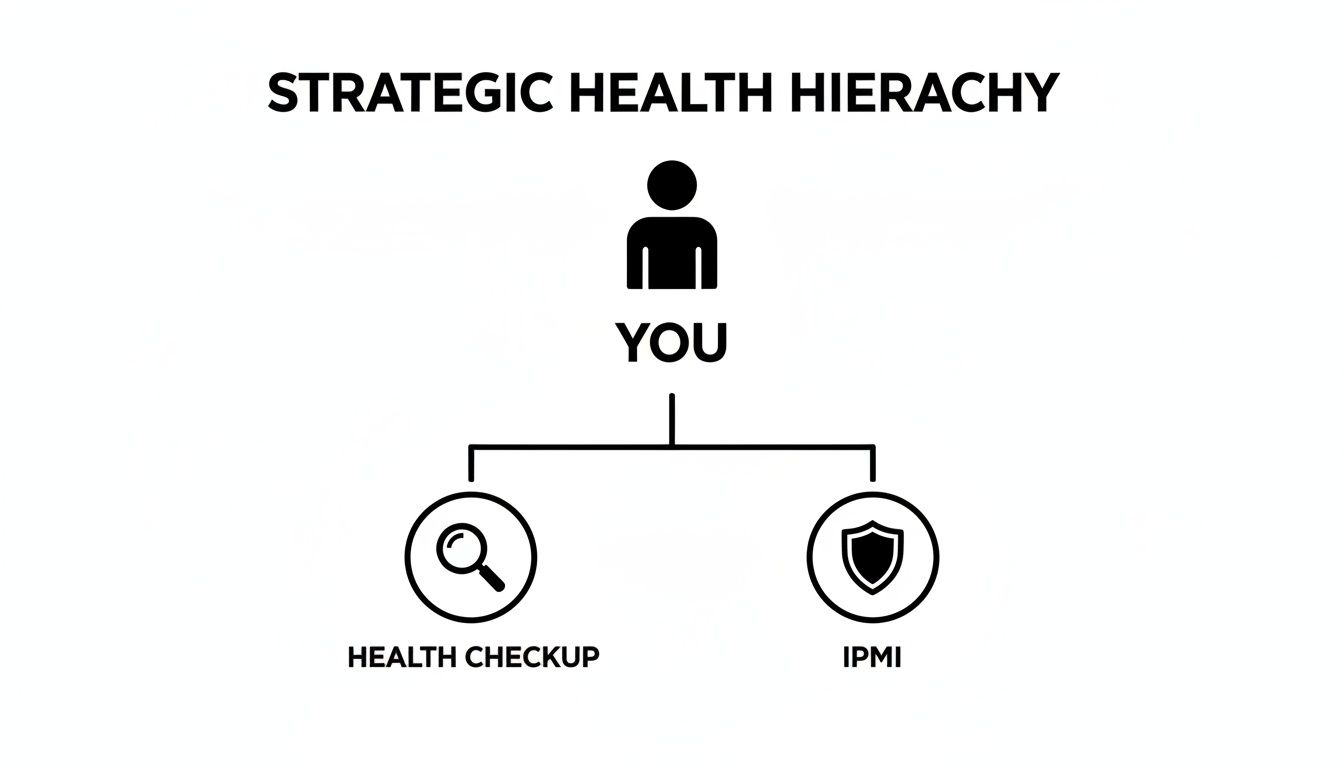
This underscores a simple but powerful concept: your check-up and your insurance are the twin pillars supporting your personal well-being and your capacity to perform at the highest level.
The Strategic 'Why' Behind Advanced Tests
Every test in an executive screening is selected for a specific, strategic reason. For example, a detailed analysis of your cortisol levels is especially relevant for individuals in high-stakes roles. Chronically elevated stress hormones can impair everything from immune function to mental clarity. Similarly, advanced cardiac screenings are non-negotiable for mitigating the risks associated with a demanding, travel-intensive lifestyle.
To better understand the diagnostic options available, it is worth examining the differences between blood tests against advanced imaging scans offered by today's leading health-tech firms.
The objective of an executive health screening is not just to detect disease, but to optimize wellness. It provides the high-resolution data needed to make precise adjustments to your lifestyle, nutrition, and stress management for sustained peak performance.
Ultimately, investing in this level of detail confers a distinct advantage. It places a personalized health roadmap in your hands, shifting you from a reactive stance on health to a proactive, data-driven strategy. This empowers you to make informed decisions that protect your health, enhance your performance, and secure your future.
Tailoring Assessments by Age and Lifestyle
Treating a health check-up like a generic, off-the-shelf product is an error in judgment. It may cover the basics, but it will not fit your specific needs, nor will it deliver optimal performance. For successful professionals, a one-size-fits-all approach to health is as insufficient as it is for a financial portfolio. Your personal health strategy must be meticulously tailored, adapting to different life stages and accounting for your unique risk profile.
Just as an investment strategy evolves from aggressive growth in one's youth to wealth preservation later on, your approach to preventive health must also adapt. The risks faced in your 30s are fundamentally different from those in your 50s. A truly effective health plan requires a dynamic screening schedule that anticipates and addresses these shifts with precision.
The Foundation in Your 30s
In your 30s, the objective is to establish a strong health baseline and identify lifestyle factors that could become future liabilities. This decade is not merely about feeling well; it is about constructing the foundation for long-term well-being. Even if you feel you are at your peak, this is the critical window to detect the silent, early warning signs of chronic conditions.
Core screenings during this period should include:
- Comprehensive Blood Analysis: This goes far beyond a basic panel. It includes a detailed lipid profile (HDL, LDL, triglycerides), fasting glucose, and HbA1c to obtain a clear picture of your metabolic health. It also establishes crucial baseline numbers for key organ function, including your liver and kidneys.
- Cardiovascular Benchmarks: Regular blood pressure checks and a baseline electrocardiogram (ECG) are non-negotiable. These simple tests provide a snapshot of your heart’s current state, creating an invaluable reference point for all future assessments.
- Lifestyle and Genetic Risk Assessment: A detailed discussion about your family's medical history, combined with your personal habits (stress levels, travel frequency, diet), is essential. This helps identify potential genetic predispositions or lifestyle risks that may demand closer monitoring in the future.
Strategic Screening in Your 40s
This decade often marks a period of peak professional responsibility, which typically entails more stress and less time for self-care. It is not surprising, then, that health risks—especially cardiovascular ones—begin to accelerate. In your 40s, your health check-up must shift from baseline monitoring to active risk mitigation.
This is the decade where early, proactive screening for heart disease and metabolic issues delivers the greatest return on investment. Identifying subtle changes now can prevent a major health event later.
Key additions to your screening regimen should include:
- Advanced Cardiac Screening: It is time to look deeper. Consider a Coronary Artery Calcium (CAC) score, a non-invasive CT scan that measures calcified plaque in your arteries. A stress test might also be recommended to see exactly how your heart performs under physical pressure.
- Early Cancer Detection: For men, a baseline Prostate-Specific Antigen (PSA) test is often introduced. For women, mammograms become a standard part of the annual routine. These are critical tools for detecting cancer at its earliest, most treatable stages.
Comprehensive Diagnostics in Your 50s
Upon entering your 50s, the focus broadens to include age-related conditions such as cancer, osteoporosis, and more complex cardiovascular issues. Your annual health check-up needs to become more comprehensive, incorporating advanced diagnostics to provide a high-resolution view of your well-being.
- In-Depth Cancer Screenings: Colonoscopies become a standard and vital screening tool for both men and women. Their ability to detect and remove precancerous polyps is a game-changer in cancer prevention.
- Bone Density Measurement: A DEXA scan to measure bone mineral density is crucial, especially for women, to preemptively address osteoporosis risk.
- Hormonal and Vascular Health: A detailed review of hormone levels can offer powerful insights into your body’s aging process. Advanced vascular screenings, like a carotid artery ultrasound, can check for blockages that might increase stroke risk.
Advanced Assessments for 60 and Beyond
Beyond 60, preventive health is about preserving function, cognitive sharpness, and overall quality of life. Screenings become highly personalized, focusing on the specific risks associated with aging. This means adding advanced cognitive assessments to establish a baseline for neurological health, comprehensive hearing and vision tests, and more frequent monitoring of all established health markers.
The discipline of consistent preventive care cannot be overstated, particularly when global events can disrupt access to healthcare. For instance, between 2019 and 2021, global life expectancy fell by 1.8 years, partly due to interruptions in routine health services worldwide. This starkly illustrates the value of maintaining a consistent and accessible preventive care strategy. You can learn more about how global events impact health trends from the United Nations. This disciplined approach is fundamental to managing long-term risks effectively.
From Preparation to Interpreting Your Health Data

A health screening yields the greatest value when approached with the same diligence as a major business meeting. Thorough preparation ensures the data collected is clean and accurate. Subsequently, understanding the implications of the results transforms that raw data into a tangible health strategy.
The initial steps are simple but absolutely critical. Just as market conditions can skew a financial report, your actions immediately before your screening can alter key biomarkers. Adhering to the clinic's instructions is not a mere suggestion—it is essential for a reliable assessment.
Securing Accurate Data: The Preparation Phase
Consider the preparation phase as controlling for variables in a scientific experiment. To obtain a true snapshot of your body's baseline function, it is necessary to remove short-term "noise" that can skew results. This ensures the insights from your health check up are based on your genuine physiological state, not temporary fluctuations.
The most common—and most important—protocol is fasting. You will almost certainly be instructed to abstain from all food and drinks (except plain water) for 8 to 12 hours prior to your appointment. This is non-negotiable for obtaining accurate blood glucose and lipid panel readings, as these are highly sensitive to recent food intake.
Beyond fasting, here are several other key steps:
- Medication Review: Discuss your current medications and supplements with the clinic beforehand. You may need to pause certain non-essential supplements, but always continue prescribed medications, such as those for blood pressure, unless specifically instructed otherwise by a physician.
- Alcohol Abstinence: Refrain from consuming alcohol for at least 24 to 48 hours before your screening. Alcohol can interfere with liver function tests and triglyceride levels, providing a misleading picture of your health.
- Compile Your History: Arrive with a concise summary of your personal and family medical history. This context is invaluable for the consulting physician, enabling them to interpret your results with a deeper understanding of your personal risk profile.
Transforming Your Report into an Executive Summary
Following your health check up, you will receive a detailed report. It may appear as a dense document filled with medical terminology, but your objective is to distill it into an executive summary of your health—identifying your key performance indicators (KPIs), spotting trends, and flagging areas that require strategic intervention.
Focus on the narrative the numbers are telling. Do not view them as isolated figures; they are interconnected data points reflecting the performance of your body's complex systems. To better understand how this data influences your insurance and care options, exploring the role of specialized medical networks can provide valuable context.
Your health report is not a final verdict; it is your personal dataset. The goal is to shift from passively observing the numbers to actively managing them. Track the trends over time and make informed, data-driven decisions about your health.
Demystifying Your Key Biomarkers
To truly make sense of your report, it is beneficial to understand a few core biomarkers and their implications in plain language. Consider these the main metrics on your personal health dashboard.
- Lipid Panel (Cholesterol & Triglycerides): This is not simply about "good" versus "bad" cholesterol. It is a measure of how efficiently your body manages and transports fats. High triglycerides or unfavorable LDL particle counts can signal that your metabolic engine is not operating at peak efficiency.
- HbA1c (Glycated Hemoglobin): This number provides a three-month average of your blood sugar levels, offering a much more stable and strategic view than a one-off glucose reading. It is a crucial indicator of how your body manages energy and your long-term risk for metabolic disorders.
- Inflammatory Markers (e.g., hs-CRP): High-sensitivity C-reactive protein measures low-level, chronic inflammation within your body. Think of it as a system-wide stress indicator; when elevated, it is linked to a higher risk for future cardiovascular events.
As you delve into your health data, understanding key tests like an ECG can be incredibly empowering. For those who wish to gain a deeper understanding, a Stanford Cardiologist explains how to interpret your ECG results. Arming yourself with this level of knowledge transforms your annual review from a passive check-in into a collaborative planning session with your physician for your long-term health.
Navigating IPMI Underwriting After Your Screening

The report from your executive health check up is more than a snapshot of your well-being. It is a crucial component of your financial architecture, particularly when securing International Private Medical Insurance (IPMI). Once obtained, these results become a central document in the insurance underwriting process—the methodical risk assessment that dictates your policy’s terms and, ultimately, its price.
Think of an underwriter as a risk analyst for your health. Their function is to construct an accurate profile to predict your potential healthcare needs. Your detailed screening report provides them with precisely what they require: hard data to make an informed, fact-based decision, moving beyond generic risk pools to assess you as an individual.
The Underwriting Process Demystified
Underwriting is the mechanism by which insurers balance risk. Upon receiving your application and medical disclosures, which will include the findings from your recent screening, the underwriting team commences its assessment. They compare your information against their risk models, searching for any indicators of current or future health issues that could lead to significant claims.
A clean bill of health from a comprehensive screening is a powerful asset. It signals low risk to the insurer. This often translates directly into a smoother approval process and, quite possibly, more favorable premium rates because you have provided undeniable evidence of your excellent health status.
Conversely, if your screening uncovers a new finding—for instance, elevated blood pressure or borderline high cholesterol—this information must be disclosed. Transparency is paramount. Concealing a known condition can lead to the denial of claims or, in a worst-case scenario, the cancellation of your entire policy when you need it most.
Potential Outcomes of Your Health Disclosure
When an underwriter analyzes your health data, several outcomes are possible. Understanding these potential scenarios beforehand allows you to approach the process with clear expectations, prepared for how an insurer might respond to your specific health profile.
The most common underwriting decisions are:
- Standard Acceptance: If your health check-up reveals no significant issues, your application is likely to be accepted at the standard premium. This is the optimal outcome and the most common for individuals who actively manage their health.
- Premium Loading: For manageable, well-controlled conditions (such as mild hypertension), an insurer may apply a premium loading. This means your premium will be a specified percentage higher than the standard rate to offset the slightly elevated risk.
- Coverage Exclusions: If a specific pre-existing condition is identified, the insurer might offer you a policy with an exclusion. This means they will cover you for everything except costs directly related to that one condition.
- Application Postponement: In rare instances, if a condition requires further investigation or is not yet stable, the insurer may postpone their decision for a set period, typically 6 to 12 months, until the clinical picture is clearer.
- Application Decline: While uncommon, a decline is possible if a condition presents a risk level that the insurer is not equipped to cover under their standard policy terms.
The Strategic Value of Proactive Screening
Obtaining a health check up before you apply for or renew your IPMI policy is a significant strategic advantage. A favorable report becomes a powerful negotiating tool, helping to streamline the entire process and secure the best possible terms.
Full transparency, backed by recent and detailed medical data, is the foundation of a sound insurance contract. It minimizes ambiguity and protects you from future disputes, ensuring your coverage is reliable when it matters.
This proactive approach transforms a routine check-up into a critical step for securing your global financial and personal well-being. By aligning your health data with your insurance strategy, you can confidently secure the protection you require. To better understand how these policies are constructed, exploring the fundamentals of International Private Medical Insurance can provide essential context.
Ultimately, when you take control of your health narrative with hard data, you demonstrate a commitment to risk management that underwriters respect. It positions you not as an unknown liability, but as a well-informed and responsible partner in your own long-term health.
Comparing Costs and Logistics in Global Hubs
For a global professional, proactive health management is a logistical exercise. Arranging an executive health check-up must be seamless, whether at your primary residence or integrated into a demanding business travel schedule. To make an informed decision, you must understand the landscape of costs and accessibility in key financial hubs such as London, Singapore, Dubai, and Geneva.
The cost of an executive screening is not standardized. It is a direct reflection of a city's cost of living, a clinic’s reputation, and the depth of the diagnostic assessment. The price point is an indicator of the service level, access to top-tier specialists, and the sophistication of the technology employed. This variability allows you to align your health investment with your specific needs and location.
A Snapshot of Executive Health Costs
To provide actionable intelligence, it is helpful to see what a typical investment looks like in these major centers. Here is a realistic overview of what you can expect to pay for a comprehensive executive health screening package.
- London: In prestigious Harley Street or Kensington clinics, expect to invest anywhere from £2,500 to £7,000. The higher end of that range typically includes advanced cardiac imaging and deep-dive biomarker analysis.
- Singapore: Known for its world-class medical infrastructure, a top-tier screening at a facility like Mount Elizabeth or Raffles Hospital will generally range from SGD 4,000 to SGD 9,000.
- Dubai: At leading institutions within Dubai Healthcare City, comprehensive packages are priced from approximately AED 10,000 to AED 25,000, often incorporating the latest diagnostic technology.
- Geneva: Reflecting Switzerland's reputation for precision and quality, executive assessments in private clinics around Lake Geneva range from CHF 3,500 to CHF 8,000.
These figures are solid benchmarks. Your final cost will vary depending on any personalized add-ons you select, such as genetic testing or consultations with highly specialized physicians.
Beyond Price: Logistical and Cultural Factors
While cost is a major component, the logistics of securing a high-quality health check up are equally critical for a time-constrained professional. Factors such as appointment availability, a clinic’s international reputation, and cultural nuances in patient care play a significant role in the overall experience.
For example, systemic issues like long waiting times and high patient volumes are common in many national health systems. This reality highlights the immense value of private executive health programs, which are designed for efficiency and personal attention. You can find more insights on global health utilization patterns on projecthope.org.
Selecting a clinic is about more than its price list. It is about choosing an environment that values your time, delivers exceptional care, and understands the expectations of a global clientele.
You should also consider factors like multilingual support, the seamless coordination of different specialist appointments, and the timely delivery of a detailed, actionable health report. For expatriates, understanding local healthcare norms is also key, and our detailed country guides offer invaluable intelligence on navigating medical systems in major global hubs. These are the logistical details that distinguish an adequate screening from a truly premium experience.
Your Questions Answered: Executive Health & Insurance
When it comes to executive health and its connection with your international insurance, a few key questions consistently arise. Here are direct answers to the issues that concern global professionals like you.
How Often Should I Get an Executive Health Check-Up?
For individuals under 40 with no significant adverse health history, a comprehensive assessment every two or three years is a prudent baseline. This frequency is sufficient to monitor your health status without being excessive.
Once you reach 40—or if you have known risk factors such as a family history of certain diseases—an annual assessment is strongly recommended. Consider it a strategic annual review. This cadence allows you to track key health markers closely and detect any age-related shifts before they become significant problems.
Is My Health Data Automatically Sent to My Insurer?
Absolutely not. Your medical information is your private data and is protected by strict confidentiality laws. It is never automatically shared with any insurance company. You maintain complete control over its dissemination.
When applying for a new IPMI policy, you are obligated to disclose your health status. Sharing the results from a recent screening at that juncture is advantageous. It makes the underwriting process transparent and ensures your policy is accurately priced from the outset. However, the decision of when and how to share that information rests entirely with you.
Your personal health report is confidential data. It is only provided to an insurer with your explicit consent during a formal application or renewal, placing you in control of the underwriting dialogue.
Can an Insurance Broker Book My Health Screening for Me?
While specialist brokers like us do not arrange the medical appointments themselves, our role is crucial in the subsequent steps. We assist you in identifying an IPMI plan that provides robust coverage for preventative care, including these high-value diagnostic screenings.
Our primary expertise is advising you on how to utilize your policy for these check-ups. More importantly, we help you navigate any underwriting issues that may arise from your results, ensuring your health and financial strategies are perfectly synchronized for your global lifestyle.
Navigating the complexities of international medical insurance should not be a solo endeavor. At Riviera Expat, we provide the clarity and control you need to secure a policy that truly supports your executive health goals. Learn more about how we can assist you at https://riviera-expat.com.