
Relocating to France is a significant portfolio decision for high-net-worth individuals. Success for expats in France hinges on a strategic plan that goes far beyond generic checklists. It demands a sharp focus on the critical pillars of your financial, legal, and personal well-being, requiring meticulous planning from the outset.
An Executive Introduction to Relocating to France
Embarking on a move to France is more than changing your address—it is the beginning of a new chapter for your personal and professional life. For executives and discerning professionals, this transition requires a clear-eyed understanding of both the opportunities and the complexities involved. When executed correctly, your assets are protected and your integration into French society feels seamless.
Think of this guide as your strategic blueprint. We will skip the surface-level tips and proceed directly to a sophisticated overview of what it takes to build a prosperous life in France. Consider this the pre-arrival briefing you need to land in a position of strength.
The Pillars of a Successful Transition
A successful move is built on several key foundations. Each one needs careful consideration and expert guidance to align with your specific circumstances. Our goal is to bring clarity to these core areas:
- Premium Residency Pathways: Understanding your options, especially the 'Passeport Talent' visa, is the first step to securing your legal status efficiently.
- Healthcare Navigation: We will delineate the differences between the state system, a top-up 'mutuelle', and comprehensive International Private Medical Insurance (IPMI).
- Wealth and Tax Strategy: A foundational grasp of income tax, social contributions, and the real estate wealth tax is non-negotiable for protecting your assets.
A proactive approach isn't about logistics; it's about structuring your financial, legal, and personal affairs to thrive in your new environment. The expats who succeed in France are the ones who plan with precision.
Ultimately, this guide will arm you with the foundational knowledge to engage confidently with your legal and financial advisors. By understanding these pillars, you can ensure every aspect of your move is meticulously planned for long-term success, right from your very first day in France.
Navigating French Residency and Visa Pathways
Before you can enjoy an espresso at a Parisian café or close a deal in La Défense, you must secure your legal status. Obtaining the correct residency is the single most important first step in any successful relocation to France. It is the master key that unlocks everything else—from opening a bank account to acquiring your desired property on the Côte d'Azur.
For high-net-worth individuals, seasoned entrepreneurs, and top-tier professionals, France offers several premium residency tracks designed to attract global talent and investment. The key is to understand which pathway aligns perfectly with your personal and professional ambitions.
The journey starts by identifying which visa fits your unique situation. This simple flowchart can help clarify your first move.
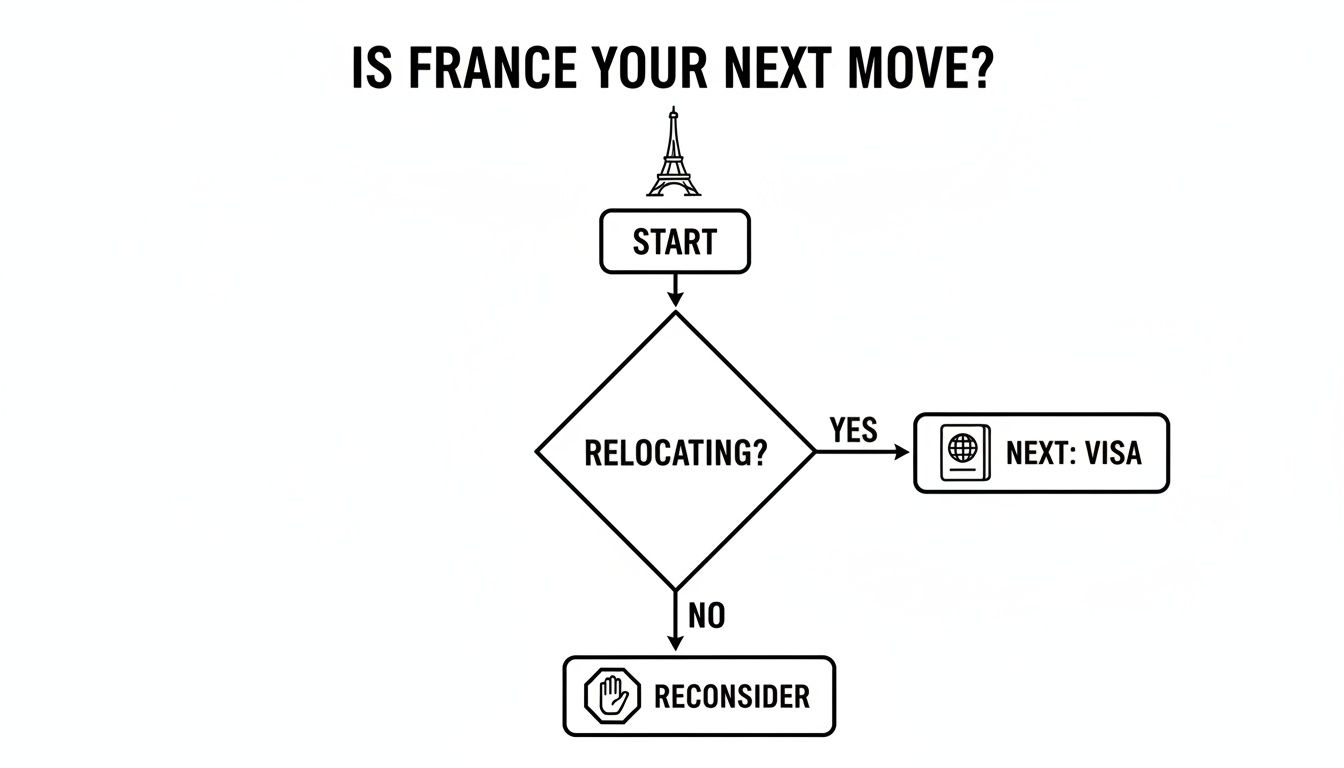
As you can see, once you have committed to the move, securing the right visa becomes your immediate focus. It is the foundational piece of the entire puzzle.
H3: The Passeport Talent: A Premier Option
At the heart of France’s pitch to the world's best and brightest is the 'Passeport Talent' (Talent Passport). This is not just one visa; it is a versatile, multi-year residence permit with several distinct categories, each tailored to a specific professional profile.
Think of it as an exclusive access pass. It offers a streamlined process that grants you and your immediate family the right to live and work in France for up to four years, with the option to renew. It allows you to bypass much of the standard, often cumbersome, immigration process.
The key categories most relevant for our clients include:
- Business Creator: For founders launching a genuinely viable enterprise in France.
- Company Director (Mandataire Social): For executives appointed to a senior corporate role within a French company.
- Innovative Project Leader: For visionaries whose project is recognized by a French public body for its innovative nature.
- Investor: This requires a significant personal investment into a French company’s fixed assets.
Each category comes with its own set of financial and professional hurdles. The investor stream, for instance, requires a direct investment of at least €300,000 and a solid commitment to creating or maintaining jobs in France. Perfecting your documentation is non-negotiable for proving you meet these criteria.
H3: An Evolving Immigration Landscape
France's legal framework for expats is dynamic. On January 26, 2024, a significant immigration law was enacted, which will introduce changes impacting foreign nationals in the country. Official statistics from INSEE in 2023 reported that 7 million immigrants (foreign-born individuals) were living in France.
A key change is the creation of a new 'Talent' residence permit for medical and pharmacy professions. More significantly for process, the law mandates that all residence permit procedures must be fully digitalized by December 31, 2024, which will fundamentally alter the application experience.
H3: Other Long-Stay Visa Options
But what if the Talent Passport does not quite fit your circumstances? France has other solid, well-established routes to residency. The most common alternative is the 'Visa de Long Séjour valant Titre de Séjour' (VLS-TS).
This visa is a two-for-one: it serves as both your entry visa and your initial one-year residence permit. It is often the ideal choice for financially independent individuals who do not plan to work, or for professionals in roles that fall outside the Talent Passport's specific categories.
After your first year, you transition to a multi-year residence card, the 'carte de séjour pluriannuelle'. While this path involves a few more administrative steps than the Talent Passport, it is a reliable and well-trodden route to making France your home.
Here is a quick comparison of the most common pathways to help you see which might be the best fit for you.
Key French Residency Pathways for HNWIs
| Permit Type | Primary Eligibility Criteria | Typical Validity | Key Benefits |
|---|---|---|---|
| Passeport Talent (Investor) | Direct personal investment of €300,000+ in a French company's assets and a commitment to job creation/maintenance. | Up to 4 years, renewable | Streamlined process, immediate family included, fast-track to long-term residency. |
| Passeport Talent (Business Creator) | A serious and viable business plan with an initial investment of at least €30,000. Must hold a master's degree or have 5 years of professional experience. | Up to 4 years, renewable | Right to work for yourself, family included, direct access to the French market. |
| Passeport Talent (Company Director) | Appointed as a legal representative in a French company, with a gross annual salary of at least 3 times the French minimum wage (SMIC). | Up to 4 years, renewable | Ideal for senior executives, provides stability for long-term corporate assignments. |
| VLS-TS (Visitor) | Proof of sufficient financial resources to live in France without working (equivalent to the French minimum wage, currently approx. €1,398 net/month per person). Must have comprehensive private health insurance for the duration of the visa. | 1 year, then apply for a multi-year card | Simpler application for those who are financially independent. Good for retirees or those on a sabbatical. |
This table provides a high-level overview, but the details are paramount. Each path has nuances that could make it a perfect fit or a non-starter depending on your specific goals.
The optimal visa choice is one that aligns not just with your immediate plans but also with your five-to-ten-year vision. Consider your professional trajectory, your family's needs, and your long-term wealth management strategy before you commit.
Ultimately, choosing the right entry point into France requires a clear understanding of what lies behind each option. Making the best selection from the outset will save you time, capital, and administrative challenges, ensuring your transition is as smooth as possible. For a wider look at the logistics of moving, feel free to explore our other country guides.
Mastering the French Healthcare System
Understanding France’s two-tiered healthcare structure is fundamental for any expat requiring premier medical coverage. The country is renowned for its high standard of care, but navigating the system effectively requires a clear strategy, especially for high-net-worth individuals who expect a superior level of service and access.
The state system, known as 'Protection Universelle Maladie' (PUMa), is the foundation of French healthcare. Once you are a legal resident and properly registered, PUMa offers excellent coverage for a vast range of medical needs. It is a co-payment system, which typically reimburses about 70% of the costs for a standard doctor's visit and 80% for hospital stays, after a small fixed daily charge. While this is a fantastic safety net, it leaves a significant gap that must be planned for.
For most expats in France, this is where private insurance shifts from being an optional extra to an absolute necessity for financial peace of mind and truly comprehensive protection.

Differentiating Top-Up and Global Insurance
The private insurance market here offers two very different solutions, and selecting the right one is critical. The most common option you will encounter is a 'mutuelle'. This is a French top-up plan designed for one specific function: to cover the co-payments left by the state PUMa system. It is a very effective and popular way to bridge the gap for routine healthcare costs within France.
However, for senior professionals and their families whose lives and business interests are global, a standard mutuelle often proves insufficient.
The Strategic Advantage of IPMI
This brings us to the second, far more robust option: International Private Medical Insurance (IPMI). IPMI is not just a top-up; it is a standalone, premier health plan architected for a globally mobile lifestyle. It offers a level of service, flexibility, and control that a mutuelle cannot match. For many expats in France, particularly those with global business interests or family ties, IPMI is unquestionably the superior choice.
IPMI provides a seamless, white-glove healthcare experience, ensuring you have complete control over your medical decisions, regardless of where you are in the world. It aligns with the lifestyle of individuals who demand efficiency, quality, and direct access.
IPMI plans are specifically designed to deliver benefits that are essential for a high-net-worth lifestyle:
- Access to Private Clinics and Specialists: Gain immediate access to France's elite private medical facilities, bypassing the wait times often found in the public system.
- English-Speaking Medical Network: Effortlessly connect with top-tier, English-speaking doctors, specialists, and hospital staff, removing any language barrier during critical moments.
- Global Portability: Your coverage travels with you. It is valid whether you are on a business trip to Singapore, a family holiday in the United States, or visiting your home country.
- Direct Billing ('Tiers Payant'): The insurer settles bills directly with the hospital or clinic. This means you are not required to pay substantial costs upfront and then wait weeks for reimbursement.
For a deeper analysis of how these plans work, you can learn more about international private medical insurance and its benefits for expatriates at https://www.riviera-expat.com/international-private-medical-insurance/. To truly master the system, it's also worth exploring options like International Health Insurance for Expats for detailed insights into global coverage.
Ultimately, the choice between a mutuelle and an IPMI plan comes down to your priorities. If your life and medical needs are contained entirely within France, a mutuelle may suffice. However, if you require global flexibility, premier access, and the convenience of direct, multilingual service, an IPMI plan is the definitive solution for protecting your family’s health and well-being.
Strategic Tax and Wealth Planning in France
Moving to France is not just a change of address; it is a fundamental shift in how you must manage your finances. For affluent individuals, this goes far beyond logistics. It is about strategically preserving your wealth within a completely different system.
What worked in your home country is now the old playbook. France has its own rules, and understanding them is essential for protecting and growing your global assets. This is not formal tax advice, but rather a high-level briefing to help you ask the right questions with your financial and legal teams.
The French system is notoriously detailed and operates differently than what you might be used to, especially if you come from a common law country. You will quickly become familiar with the progressive income tax (impôt sur le revenu), various social security charges (prélèvements sociaux), and the real estate wealth tax (impôt sur la fortune immobilière, or IFI). The key is to plan proactively, structuring your affairs before you arrive, not after.
Are You a French Tax Resident?
Everything starts with one critical question: does France consider you a tax resident? The French tax authorities (Direction Générale des Finances Publiques) have a straightforward checklist. If you meet just one of these criteria, you are considered a resident for tax purposes.
- Your main home or family (foyer) is in France.
- You carry out your primary professional activity in France.
- France is the center of your economic interests.
Once you meet one of those criteria, you are generally liable for French tax on your worldwide income. This is why timing is so crucial. Structuring your assets and income streams before you officially establish residency can make a significant financial difference.
A common mistake is underestimating how broad these residency rules are. It is easy to accidentally trigger tax residency, leading to unexpected liabilities on your global portfolio. Obtaining absolute clarity on this point is the foundation of any sound financial strategy in France.
The Real Estate Wealth Tax (IFI)
For high-net-worth individuals, the Impôt sur la Fortune Immobilière (IFI) is a major consideration. This tax replaced the former general wealth tax and, as the name implies, focuses exclusively on real estate assets.
The IFI applies if the net value of your worldwide real estate portfolio exceeds €1.3 million. It is a progressive tax that applies only to the portion of your property wealth above €800,000, with rates starting at 0.5% and rising to 1.5%.
There is a temporary exemption for new residents: for the first five years, the IFI only applies to your French real estate assets. Your foreign property is excluded from the calculation during this period. However, any property you own inside France is included in your IFI calculation from your very first year. For anyone considering buying property here, a solid understanding property taxes and their wider implications is non-negotiable.
Don't Forget Bilateral Tax Treaties
France has a vast network of double taxation treaties with over 120 countries. These agreements are powerful tools designed to prevent you from being taxed twice on the same income.
Think of these treaties as a set of rules that decide which country has the primary right to tax different types of income, such as:
- Pensions
- Dividends
- Capital gains
- Rental income
For instance, a treaty might specify that your pension from your home country is only taxable there, not in France. Leveraging these agreements is not a DIY project; it requires an expert who can analyze your specific income sources and map them against the relevant treaty. This is one area where professional advice is indispensable for maintaining compliance while optimizing your tax position. Your advisor can help structure everything to align perfectly with the treaty between France and your country of origin.
Establishing Your Financial and Lifestyle Foundations
A successful move to France requires more than just logistics; it is about quickly laying down the financial and personal bedrock for your new life. Your banking partner and your home are the twin pillars that support everything else. Securing these correctly from the start will make your transition immeasurably smoother.
Establishing your financial infrastructure is the engine for your entire life in France. It dictates everything from your daily spending to your long-term wealth strategy. In the same vein, finding the right property is about more than just a place to live; it is about creating a personal sanctuary that fits your life and your standards.

Selecting the Right Banking Partner
For anyone with significant assets, opening a French bank account is a strategic move, not just an administrative chore. The standard high-street banks (banques de détail) are suitable for everyday transactions, but they are not equipped to handle the complexities of international wealth.
This is where the world of private banking (banque privée) becomes indispensable. These institutions operate on a completely different model, one built on personal relationships and tailored service for clients with substantial portfolios. A private banker becomes your dedicated financial concierge, your single point of contact for a suite of integrated services.
This typically includes:
- Personalized Wealth Management: They will work with you to build investment strategies that match your risk appetite and your global financial picture.
- Asset Structuring Advice: You will receive guidance on the most tax-efficient ways to hold your assets under the French legal system.
- Discreet Credit and Lending Facilities: For financing a property or another major investment, they provide access to specialized lending that retail banks do not offer.
Choosing a private bank is about more than just service; it's about partnering with an institution that understands the nuances of cross-border wealth. They provide the sophisticated framework you need to manage a global portfolio from your new home base in France, ensuring compliance while you continue to grow your assets.
Acquiring Luxury Property in France
Finding the perfect home is a cornerstone of building your new life. France is home to some of the world's most sought-after property markets, each with its own unique character. Whether you are seeking a chic apartment in Paris, a waterfront villa on the Côte d'Azur, or a sprawling country estate in Provence, you will find the market is both competitive and nuanced.
The choice between buying and renting is deeply personal. Renting can offer valuable flexibility as you first settle in and get a feel for the area. But if you have a long-term vision for your life in France, purchasing a property is a major investment that allows you to truly establish roots.
Demand in these prime locations is consistently high, driven in part by a growing international community. INSEE's 2023 data reported France's immigrant population (foreign-born) at 7 million, a notable increase from previous years. This trend keeps major hubs like the Paris region highly active.
Engaging a Property Finding Specialist
Navigating these high-stakes property markets independently is a formidable task. This is where a chasseur d'appartement—a dedicated property finder or buyer's agent—can be a game-changer. Unlike a standard real estate agent who works for the seller, a chasseur works exclusively for you.
Their role is to deeply understand your requirements and then leverage their insider network to unearth off-market or pre-market properties you would never find otherwise. This is invaluable for clients who prize discretion and efficiency.
A good chasseur manages the entire process, from the initial search and shortlisting to negotiating the best price and coordinating with the notaires. Their local market intelligence is your best defense against overpaying and your surest path to securing your ideal home on optimal terms.
For a deeper dive into the logistics of moving, our guide on preparing for your move abroad offers more practical insights. Getting these financial and property foundations sorted early is the key to a smooth and prosperous start to your new life in France.
Choosing an Educational Path for Your Family
For families moving to France, few decisions are as significant as choosing a school. This choice extends beyond academics; it shapes your children's future, their integration into a new culture, and the entire family's experience. You are balancing the allure of deep cultural immersion against the practical need for academic continuity.
The path you choose depends on your long-term vision. The French public school system is the most direct route to true fluency and cultural assimilation. Placing your child in a local école, collège, or lycée provides full immersion, which is the fastest way for them to become genuinely bilingual and feel at home in French society.
However, for many global executives, that path presents uncertainty. When your career could take you to another global hub next, internationally recognized qualifications are a necessity. This is precisely where international schools excel.
International Schools for Global Citizens
The most prestigious international schools are clustered in major expat hubs: Paris, Lyon, and the Côte d'Azur. They are structured to serve the global executive community. Instruction is almost entirely in English, which immediately smooths the academic transition for children not yet fluent in French.
More importantly, these schools offer qualifications that university admissions officers from London to Boston understand and respect. The three main curricula you will encounter are:
- The International Baccalaureate (IB): A rigorous, world-renowned program highly regarded by top universities.
- British A-Levels: The gold standard for entry into UK universities and a credential that is widely accepted elsewhere.
- American High School Diploma & AP Courses: The clear choice for families planning to return to the US or targeting American universities.
Choosing an international school is an investment in your family's global mobility. It creates a stable, familiar academic structure that ensures your child’s education remains on track, no matter where your next assignment takes you.
Navigating Admissions and Costs
Demand for places at top-tier international schools in France is fierce. The admissions process is competitive, often beginning a full year before the start of term. The price tag reflects this elite status, with tuition typically ranging from €15,000 to over €35,000 per year, depending on the school and your child's age.
This high demand is fueled by the concentration of English-speaking expats in the same major cities. According to 2023 INSEE data, of the 45,000 US citizens registered as living in France, a significant portion resides in the Paris (Île-de-France) region. You can find more data on this at AmericanEmigration.com. This concentration creates a powerful magnet for jobs and services but also intensifies competition for everything, especially school placements. Securing a spot requires a strategic and, above all, early approach.
Your Questions Answered
Moving to France is a significant undertaking, and it is natural to have questions. Here are straightforward answers to the queries we hear most often from high-net-worth individuals planning their relocation.
What Is the Most Common Mistake Expats Make?
The single biggest misstep is assuming you can resolve critical matters after you arrive. Many successful individuals believe they can land first and then arrange their tax, residency, and banking affairs.
However, French bureaucracy, especially concerning tax residency, moves quickly and has a long reach. If you have not structured your global assets and income streams before you officially establish residency, you could face significant tax liabilities on your entire worldwide portfolio. Engaging your legal and financial advisors from the very beginning is essential for protecting your wealth.
Is IPMI Really Necessary if I Have State Coverage?
France’s state healthcare system, PUMa, is excellent for its intended purpose—a solid public foundation. But it was not designed for the needs of a global executive. The system typically covers only 70-80% of costs, and you may encounter wait times for appointments with certain specialists.
International Private Medical Insurance (IPMI) is an entirely different class of service. It is about immediate access to premier private clinics, the ability to choose English-speaking doctors, and seamless global coverage that travels with you. If you value your time, choice, and convenience, IPMI is not a luxury; it is a strategic necessity.
For discerning expats in France, the conversation is not about having basic coverage. It is about ensuring a continuity of world-class care, maintaining full control over medical decisions, and enjoying the ease of direct billing that eliminates out-of-pocket expenses.
How Much Capital Is Needed for an Investor Visa?
The 'Passeport Talent' for investors is a well-defined path, but it demands a serious, direct commitment to the French economy. To qualify, you must personally invest at least €300,000 into the tangible or intangible assets of a French company. This can be a company you own outright or one in which you hold at least a 10% stake.
The requirement does not stop there. This investment must be tied to a credible business plan that will create or maintain jobs in France within four years. This is not a passive investment route; it is a visa designed for hands-on investors ready to make a tangible contribution.
Navigating your health coverage should be the simplest part of your move. At Riviera Expat, we specialize in providing clear, expert guidance on international medical insurance, ensuring you and your family have premier protection from day one.