
For a discerning international professional relocating to the United States, securing appropriate health insurance is a foundational component of both personal and financial strategy. A standard domestic policy from your home country is fundamentally inadequate for the complexities and high costs of the US healthcare system. Its provider networks and financial structures are simply not designed to operate within this unique environment.
The premier solution for comprehensive protection and asset preservation is a robust International Private Medical Insurance (IPMI) plan. This is the only class of coverage engineered to meet the sophisticated needs of a global citizen residing in the US.
Why Your Health Coverage Matters in the US
Navigating the American healthcare apparatus as a foreign national presents formidable challenges. The system is predicated on private insurance, creating significant exposure for individuals without an employer-sponsored or government-subsidized plan.
This is not a minor administrative detail; it is a critical strategic consideration. Without the correct protection, a single unforeseen medical event—such as a serious accident or sudden illness—can result in catastrophic financial liability. The primary objective is to secure comprehensive coverage that insulates both your health and your wealth from the exceptionally high cost of medical care in the US.
The Coverage Gap for Non-Citizens
The necessity for private international coverage becomes evident when examining the disparities in healthcare access. Federal and state regulations often preclude non-citizens from accessing federally-funded health programs, leaving many dangerously exposed.
According to a 2023 KFF analysis, approximately 46% of undocumented immigrant adults are uninsured—a rate nearly seven times higher than the 7% for naturalized citizens. Even lawfully present immigrants face an uninsured rate of 21%, significantly higher than the 8% for US-born citizens. You can review their insights on immigrant health care experiences here.
These statistics underscore a crucial point: relying on public systems is not a viable strategy. The only dependable method to ensure consistent, high-quality medical care is to proactively secure a private insurance plan. Consider it a financial safeguard, allowing your focus to remain on your professional objectives, not on potential medical liabilities.
Comparing Your Health Insurance Options
Discerning the optimal health insurance solution as a non-US citizen in the United States requires a clear understanding of the distinct categories of coverage available. Each is engineered for a fundamentally different purpose, and selecting the correct one is paramount.
Consider the following analogy:
Travel insurance is analogous to a short-term rental vehicle. It is suitable for brief, unexpected emergencies—a sudden accident or acute illness—but wholly inadequate for routine needs. It is designed for urgent medical events and typically excludes pre-existing conditions.
A domestic US health insurance plan is comparable to a local vehicle lease. It functions well within the confines of the US, tied to specific networks of physicians and hospitals. However, its coverage typically terminates at the border, rendering it unsuitable for an individual with a global lifestyle.
Finally, International Private Medical Insurance (IPMI) is akin to owning a premium vehicle with a worldwide service and support agreement. It is comprehensive, portable, and designed to move with you. Whether you are in New York, London, or Singapore, you retain access to premier coverage. This is the level of flexibility and robust protection that high-net-worth professionals require.
Matching the correct instrument to your specific requirements is fundamental to securing both your health and your financial well-being.
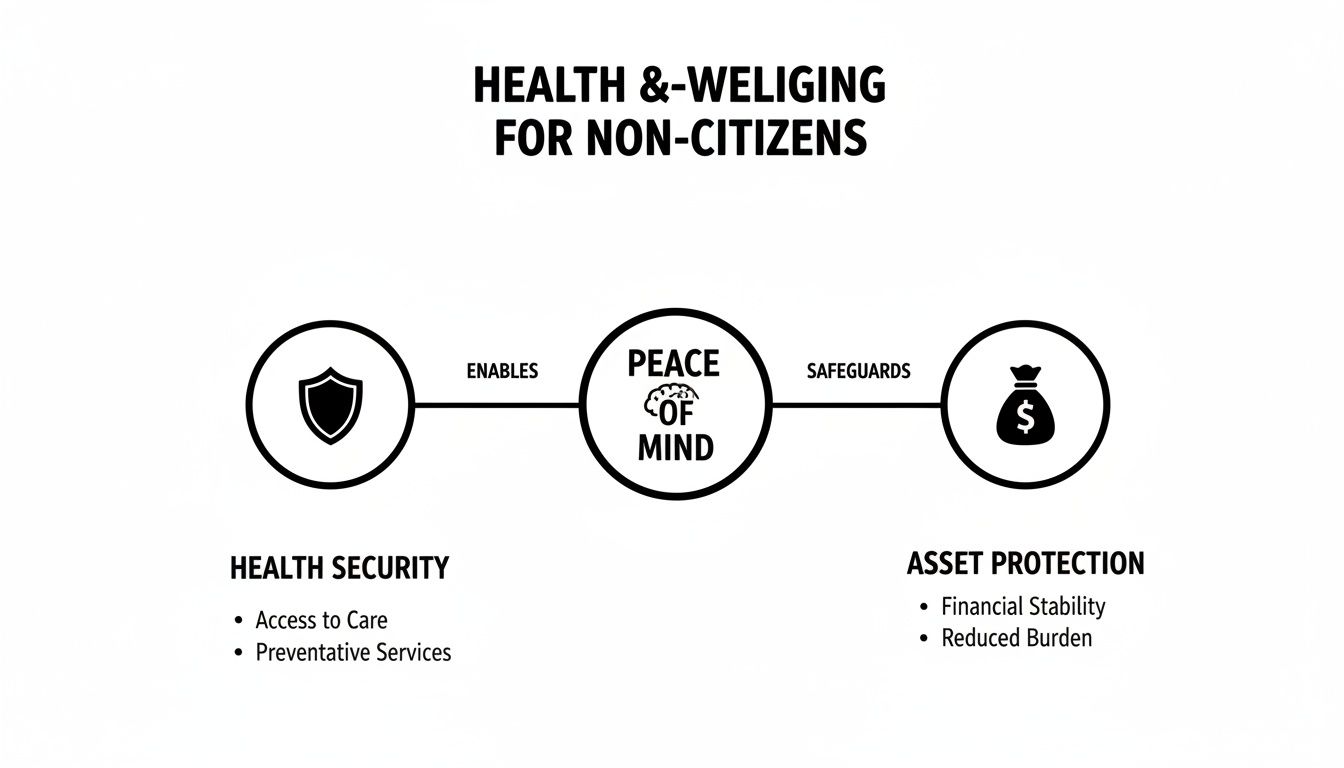
As illustrated, genuine peace of mind is achieved when your health security and asset protection are fully integrated, creating a resilient foundation for your life abroad.
To further clarify these distinctions, the following table provides a strategic comparison of how each insurance type performs for an expatriate professional.
Strategic Comparison of Insurance Types for Non-US Citizens
This table provides a high-level comparison of the primary insurance options, highlighting their suitability for different needs, coverage scope, and typical use cases for expatriate professionals.
| Feature | Travel Insurance | Domestic US Health Insurance | International Private Medical Insurance (IPMI) |
|---|---|---|---|
| Primary Use Case | Short-term trips (under 90 days), tourism, unexpected emergencies. | Long-term residency strictly within the United States. | Global professionals, expatriates, frequent international travelers. |
| Geographic Scope | Limited to outside your home country for a specific trip duration. | Typically restricted to a network of providers within the US only. | Worldwide coverage, including the US, your home country, and elsewhere. |
| Coverage Type | Emergency medical events only (accidents, sudden illness). No routine care. | Comprehensive care, including preventive, routine, and specialist visits. | Comprehensive care, often with higher limits and access to top-tier facilities. |
| Pre-Existing Conditions | Almost never covered. | Coverage varies by plan; subject to ACA rules. | Often coverable through medical underwriting, though sometimes excluded. |
| Portability | Policy is tied to a specific trip; ends upon return home. | No portability outside the US. A new plan is needed if you move abroad. | Seamlessly portable. Your coverage moves with you across borders. |
| Best For | Tourists and short-term visitors needing a basic safety net. | Lawfully present residents who do not travel internationally. | Expat executives, global entrepreneurs, and their families. |
Each option serves a distinct purpose. A mismatch between your needs and your plan is not merely an inconvenience—it is a potentially severe financial miscalculation.
Key Distinctions for Global Professionals
The fundamental difference is one of function: travel insurance is reactive, designed to address a crisis. In contrast, domestic and international health plans are proactive, structured for the long-term management of your health.
For instance, a travel policy may cover an emergency room visit for a fracture but will not cover the subsequent months of physical therapy or specialist consultations. For anyone residing and working in the US, this represents a significant and costly coverage gap.
Furthermore, obtaining a domestic US plan can be challenging. Plans on the Affordable Care Act (ACA) Marketplace are governed by strict eligibility rules. Federal law prohibits undocumented immigrants from purchasing these plans. Many lawfully present non-citizens may also encounter obstacles such as waiting periods or other restrictions, making these plans an unreliable option. You can explore these policy type distinctions in greater detail.
Why IPMI Is the Premier Choice
For most non-US citizens leading a global life, the logical choice is international health insurance for a simple reason: it is engineered for your specific lifestyle. IPMI plans offer benefits that other policies cannot match.
The single most significant advantage of IPMI is its seamless portability and continuity of care. A quality IPMI plan provides coverage in the US, on business assignments in Asia, and during visits to your home country, eliminating the hazardous coverage gaps that arise when crossing borders.
This global scope is not a luxury; it is a necessity for professionals with international careers. It removes the administrative burden of securing new insurance for every trip and guarantees a consistent, high standard of care regardless of your location.
An IPMI plan is constructed around features that are indispensable for an expatriate:
- Comprehensive Global Coverage: You gain access to world-class physicians and hospitals, not a restrictive network confined to a single US state.
- Direct Settlement of Claims: The insurer often remits payment directly to the hospital. This is a critical feature in the US, where you could otherwise face substantial upfront payments and complex reimbursement procedures.
- Coverage for Pre-Existing Conditions: Unlike travel insurance, many IPMI plans can cover chronic conditions following a medical underwriting review.
- Medical Evacuation and Repatriation: This benefit is non-negotiable. In the event of a serious medical emergency, it covers the staggering cost of transport to a premier medical facility or back to your home country.
Ultimately, selecting health insurance is a strategic financial decision. While travel insurance is suitable for a tourist and a domestic plan works for a local resident, only IPMI delivers the robust, flexible, and borderless coverage required to properly protect both your health and your assets.
How Your Visa Status Shapes Your Insurance Needs
For a high-net-worth individual relocating to the United States, your visa and your health insurance are not independent considerations; they are deeply interconnected. Your visa grants you entry, but your health insurance provides the essential security framework that protects your life and legal status within the country. A misalignment between the two can jeopardize your entire endeavor.
For many non-immigrant visas, particularly those designed for professionals and scholars, possessing adequate health insurance is a mandatory requirement. Failure to comply with specific coverage stipulations constitutes a breach that can compromise your legal standing.

Matching Coverage to Your Specific Visa
Different visas carry distinct regulatory requirements. Your insurance strategy must be precisely tailored to the visa category under which you are entering the country.
F-1 and J-1 Visas (Students and Exchange Visitors): These visas often have the most stringent insurance mandates, typically defined by the sponsoring institution. J-1 visa holders, for example, are required by the US Department of State to maintain insurance meeting specific minimums for medical benefits, repatriation of remains, and medical evacuation.
H-1B and L-1 Visas (Specialty Occupations and Intracompany Transferees): While no federal insurance mandate is directly tied to these visas, sponsoring employers nearly always offer a group health plan. However, these domestic plans may lack the global portability or high coverage limits that a senior executive requires, creating a compelling case for a primary or supplementary international plan.
O-1 Visas (Individuals with Extraordinary Ability): As an O-1 visa holder, you are expected to be self-sufficient. Proactively securing a premier private health insurance plan is a prudent strategic move. It reinforces your petition by demonstrating to immigration officials that you are financially prepared for life in the US.
The “Public Charge” Rule and Your Financial Standing
Beyond visa-specific rules, you must be cognizant of the "public charge" rule. This long-standing immigration principle permits US officials to deny a visa or permanent residency to any applicant deemed likely to become dependent on government assistance.
Securing a robust IPMI plan sends a clear, powerful signal to immigration authorities. It demonstrates that you possess the financial resources to manage your own healthcare costs, mitigating any concern that you might become a public charge.
A premium health insurance policy is more than medical protection; it is a strategic asset for your immigration profile. It serves as tangible evidence of your financial independence and commitment to self-reliance—qualities highly valued in any visa application process.
This demonstration of financial fortitude can be particularly beneficial during future applications for visa extensions, adjustment of status, or permanent residency.
Avoiding the Pitfalls of Non-Compliance
The consequences of non-compliance are severe. A lapse in required coverage, even if inadvertent, can result in the termination of your program, revocation of your visa, and a potential ban on re-entry into the United States. It is a risk no serious professional should contemplate.
For example, a J-1 exchange visitor whose insurance fails to meet the minimum threshold for medical evacuation coverage is technically in violation of their status. Similarly, relying on a domestic US plan with no international coverage leaves you completely exposed during business travel or visits to your home country.
This is precisely why a meticulously selected health insurance for non us citizens is so vital. It ensures you not only receive superior medical care but also remain in full compliance with the complex requirements of your US visa. Your policy must be a perfect fit—for your visa, your lifestyle, and your future in the country.
Understanding the US Healthcare Cost Structure
For anyone arriving in the United States, it is essential to recognize that its healthcare system operates within a unique financial ecosystem. The scale of costs can be startling, even for a high-net-worth individual. This is not a marginal difference but a fundamental structural divergence that directly influences the type of insurance and level of financial protection required to safeguard your assets.
The US health insurance market is a behemoth, accounting for a disproportionate share of global healthcare expenditure. This concentration of capital has profound implications for anyone seeking medical services within its borders.
The data is telling. In 2023, the total health spending in the United States reached $4.8 trillion. To put this in perspective, this figure is larger than the entire gross domestic product of countries like Germany or the United Kingdom. This single statistic highlights the country's extreme cost structure relative to every other developed nation. For a deeper analysis, you can read the full global insurance report.
What this means in practical terms is that even routine medical services carry price tags that are often an order of magnitude higher than in other countries. Consequently, the insurance policies designed for this environment are a distinct class of product, with specific terms dictating your financial risk exposure.
Key Cost Drivers and Underwriting Factors
An insurer's role is to price risk, a process executed with meticulous detail in the US. The premium for your policy is a carefully calculated figure based on several factors predicting your likely utilization of the healthcare system.
For high-net-worth individuals seeking premium health insurance for non us citizens, underwriters will analyze:
- Age and Demographics: As a general principle in insurance, premiums increase with age, reflecting the statistical correlation between age and the need for medical care.
- Medical History: Your personal and family medical history, particularly any pre-existing conditions, is a critical factor in assessing potential future health needs.
- Coverage Level and Geography: A plan providing access to the most prestigious hospital networks in major US metropolitan areas will command a significantly higher premium than one with a more restricted network.
Understanding these drivers is the first step toward appreciating why a robust international health policy is not a luxury but a core component of a sound financial strategy for any expatriate in the US.
Demystifying Core Insurance Terminology
To protect your financial position, you must be fluent in the language of US health insurance. These terms define the cost-sharing agreement between you and your insurer.
These concepts are not mere fine print; they are the fundamental mechanics of your financial protection. Misunderstanding them can lead to unexpected and substantial out-of-pocket expenses, even with a premium plan in place.
Let’s dissect the three most critical components:
- Deductible: This is the amount you are required to pay out-of-pocket for medical services before your insurance plan begins to contribute. For instance, with a $1,000 deductible, you are responsible for the first $1,000 of your covered healthcare costs.
- Copayment (Copay): This is a fixed fee you pay for a specific service, such as a physician visit or prescription. You might have a $50 copay for each visit to a specialist, regardless of the total cost of the consultation.
- Out-of-Pocket Maximum: This is your financial safety net. It represents the absolute maximum amount you will pay for covered services in a policy year. Once your payments for deductibles and copays reach this threshold, your insurer covers 100% of all subsequent eligible expenses for the remainder of that year.
A well-designed IPMI plan is structured to manage these variables, providing predictable financial protection within the high-cost US system. It is also crucial to understand processes like pre-authorization and direct billing, as they significantly impact how you access care and manage payments. You may find value in our guide on how pre-authorisation and direct settlement work.
Designing Your Ideal Coverage Plan
For a senior international professional, the details of an insurance policy are not trivial; they constitute the architecture of your personal and financial safety net. A world-class International Private Medical Insurance (IPMI) plan distinguishes itself by offering clear, robust protection against the most significant risks you face, extending far beyond basic hospitalization.
Therefore, you must scrutinize how a policy addresses three critical areas: pre-existing conditions, maternity care, and emergency medical evacuations. These are not optional add-ons but core components of a plan that delivers genuine security. Understanding them is the only way to select coverage that provides true peace of mind.

Pre-Existing and Chronic Condition Coverage
A clear indicator of a premium IPMI plan is its approach to pre-existing conditions. While standard travel insurance invariably excludes them, a quality international plan often provides a path to coverage via medical underwriting—a comprehensive review of your health history to determine if and how a condition can be covered.
Similarly, effective support for chronic conditions—such as diabetes, hypertension, or asthma—is essential. A strong policy ensures continuous access to specialist consultations, prescription medications, and disease management programs, guaranteeing continuity of care regardless of your location. For a deeper look, check out our guide on understanding complex expat medical insurance policy terms.
Essential Benefits for Global Professionals
Beyond managing existing health needs, your plan must be prepared for both planned life events and sudden crises. For any professional residing in the United States, certain benefits are non-negotiable.
Maternity Coverage: If you are planning to expand your family, this coverage is indispensable. The best plans cover prenatal consultations, delivery costs (including complications), and postnatal care. Note that most policies impose a waiting period, typically 10-12 months, before these benefits become active, necessitating advance planning.
Mental Health Services: The demands of a high-stakes career in a new country can be significant. Leading IPMI plans recognize this and include comprehensive coverage for mental and behavioral health, providing access to therapists, psychologists, and psychiatrists to support your overall well-being.
Preventive Care: Proactive health management is the most effective strategy. Look for plans that fully cover routine physical examinations, cancer screenings, and vaccinations. This focus on wellness helps identify potential issues early, leading to better long-term health outcomes.
The imperative for such robust private coverage is underscored by the global health landscape. According to the World Health Organization, at least 4.5 billion people—more than half of the world's population—were not fully covered by essential health services in 2021. Furthermore, 2 billion people experienced financial hardship due to out-of-pocket health spending. These figures affirm that a comprehensive international private plan is critical to guaranteeing access to quality care.
The Critical Role of Evacuation and Repatriation
Perhaps the single most vital benefit for any expatriate is medical evacuation and repatriation. A serious medical emergency in a location lacking specialized facilities can quickly escalate into a health and financial catastrophe.
Medical evacuation is your ultimate safety net. It ensures that if you suffer a severe illness or injury, you will be transported to the nearest center of medical excellence, even if that requires a private air ambulance flight across continents. The cost of such a transport can easily exceed $100,000, making this coverage absolutely indispensable.
Consider a practical scenario: an executive on assignment in a more remote region of the U.S. suffers a major cardiac event. The local hospital is not equipped to perform the necessary advanced surgical procedure. A premier IPMI plan would immediately arrange and cover the cost of an emergency medical flight to a top-tier cardiac center in a major city.
A comprehensive plan should cover two distinct scenarios:
- Medical Evacuation: Transporting you to the nearest appropriate medical facility for treatment.
- Medical Repatriation: Transporting you back to your home country for treatment or recovery, when medically advisable.
When selecting health insurance for non US citizens, a rigorous assessment of these specific benefits is essential. A plan that excels in these areas provides a foundation of security that allows you to focus on your career, confident that you are protected against any eventuality.
Getting Your Policy in Place: The Nitty-Gritty
Understanding the landscape of health insurance for non US citizens is the first step; securing the correct policy is the next. For a busy professional, this must be an efficient, seamless process—less a purchase and more a strategic component of your relocation plan.
Securing a premier International Private Medical Insurance (IPMI) policy is a straightforward process when the steps are clear. It requires the correct documentation, precise timing, and the guidance of an expert to manage the details.
What You'll Need to Apply
Insurers require a few standard documents to initiate an application. This is a standard verification and baseline-setting procedure. Having these items prepared will expedite the process.
- Passport: A clear, valid copy of your primary photo page as proof of identity.
- Visa Information: Details of your visa type (e.g., H-1B, L-1, or O-1) to confirm your legal status and intended duration of stay in the US.
- Proof of Address: Your current residential address is required. If applying prior to your move, your address in your home country is sufficient.
With these documents, the insurer can begin the underwriting process—their detailed review of your application and health profile.
Why Timing Is Everything
In the context of health coverage, timing is a critical strategic element. Delaying this decision can create unnecessary and significant risks.
The optimal time to arrange your policy is before you depart for the United States. Premier IPMI providers are designed for this scenario, allowing you to set a future effective date that aligns with your arrival, ensuring you are covered from the moment you land.
Waiting until after you have arrived creates a hazardous gap in which you have no protection. Arranging insurance in advance removes a major logistical burden during the demanding period of an international move, freeing you to focus on your new professional role with the knowledge that your health and financial security are already in place.
This is precisely where a specialist broker adds immense value. Our role is to manage the entire process on your behalf. We handle the paperwork, liaise with insurers, and ensure the chosen policy meets your exacting standards, allowing you to concentrate on your continued success in the US.
Common Questions Answered
When arranging health insurance for a relocation to the U.S., numerous questions naturally arise. It is a complex subject, and precision is key. Here are concise answers to the questions we most frequently receive from professionals.
Can I Just Use My Insurance from Back Home?
While appealing in its simplicity, this is rarely a viable solution. A policy from your home country may offer limited coverage for a short-term emergency during travel, but it is not structured for the US healthcare system.
US hospitals and physicians operate within specific provider networks and utilize a unique billing system. Foreign insurance plans almost never have the requisite direct-billing agreements in place. This incongruity results in substantial out-of-pocket expenses and claim denials. A dedicated IPMI plan or a compliant US-based policy is essential for financial security.
How Do Insurers Handle Pre-Existing Conditions?
This is a critical question, and the approach varies among insurers. Some international plans may offer a moratorium, which involves a waiting period. They may agree to cover a condition after a specified period during which you have been free of symptoms and have not sought treatment for it.
Other, more comprehensive plans will conduct full medical underwriting. In this process, they perform a detailed assessment of your health history and may offer to cover a condition from the outset, often for an adjusted premium.
It is crucial to provide a complete and accurate disclosure of your health history during the application. A specialist broker can be invaluable here, helping to identify insurers most likely to provide favorable terms for your specific circumstances.
The key is transparency. Full disclosure during the underwriting process ensures there are no surprises later, guaranteeing your policy performs as expected when you need it most. This step is critical for securing dependable coverage.
What's the Best Time to Buy My Policy?
Ideally, your health insurance should be secured before you travel to the United States. This ensures there are no gaps in coverage; you are protected from the moment of your arrival.
Most premier providers offer the flexibility to set a future start date that aligns perfectly with your travel itinerary.
Finalizing your coverage in advance also removes a significant logistical burden. An international relocation is inherently demanding; addressing a critical item like health insurance while managing jet lag and settling in is an unnecessary complication. If your visa requires proof of insurance, having it arranged early streamlines that process as well.
At Riviera Expat, we provide the expert guidance needed to secure a world-class health insurance plan tailored to your exacting standards. We remove the complexity, allowing you to focus on your professional success with complete confidence. Explore your options with us at https://riviera-expat.com.